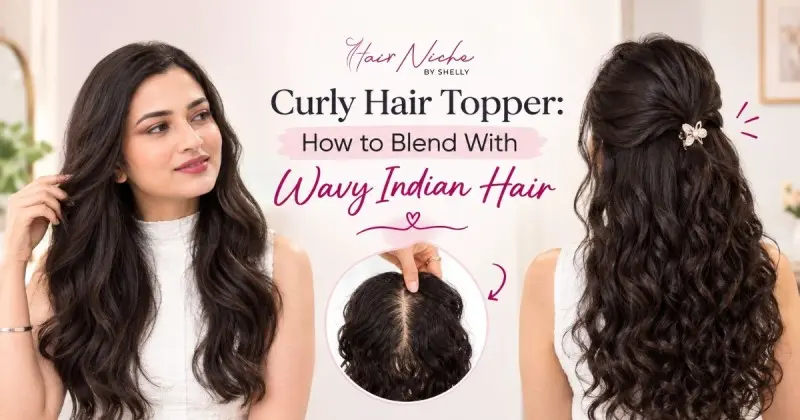
A curly hair topper blends naturally only when its curl pattern is close to your own. Match texture first, then colour, and style the piece and your hair together with the same products. If your hair is wavy rather than truly curly, a restyled straight human-hair topper often blends better.
Colour matching gets all the attention, and it matters. But if you have wavy or curly hair, there's a second match that decides whether a topper looks real — and almost nobody talks about it.
Texture. Your hair moves in a particular way, and a piece that moves differently will always read as separate, however perfect the shade.
Why texture matters more on wavy and curly hair
On straight hair, a topper sits flat against flat. There's very little for the eye to catch.
Wavy and curly hair is different. Your own hair has volume, movement and a pattern that repeats down the length. Where the topper's edge meets it, any mismatch in that pattern creates a visible seam — smooth against textured, or a tight curl against a soft wave.
This is why women with textured hair sometimes conclude toppers "don't work for them." Usually the piece was fine and the texture was wrong.
Work out your actual curl pattern first
Most people describe their hair from memory rather than observation. Do this instead: wash your hair, apply nothing, let it air dry completely, and look at what it does on its own.
- Soft bends, mostly straight until the mid-lengths — you're wavy, not curly.
- Defined S-shapes through the length — solidly wavy.
- Spirals or ringlets that hold their own shape — curly.
Most Indian hair lands in the first two categories. That distinction matters more than anything else in this post, because it changes which piece you should buy.
If your hair is genuinely curly
Match the piece to the pattern. A curly base means the topper holds its own curl without daily styling, and it moves the way your hair moves.
The Curly Volume Topper (Silk Base) is the curl-textured option in our range, on a silk base that keeps the parting realistic — important on curly hair, where the parting is often more exposed than you'd expect.
Buy the curl slightly looser than your own if you're between options. A topper marginally softer than your natural curl blends into it; a tighter curl sitting on looser hair stands out.
Wavy hair topper: the honest advice
Here's where the standard guidance falls down. If your hair is wavy rather than curly, a curly topper is often too much texture — and a genuinely wavy topper is a hard thing to find, in our range or anyone's.
The practical answer most wavy-haired women land on is a straight or natural-textured human hair topper, restyled to match. Because it's human hair, you can wave it with a wand or a diffuser exactly as you would your own, and it'll hold the same shape through the day.
The Volume Topper (Silk Base) and Essential Hair Topper (Silk Base) both take heat styling well, so you set the wave rather than hoping it matches out of the box.
That extra styling step sounds like a drawback. In practice it's an advantage: you control the match, and you can adjust it on days your own hair behaves differently.
Blend a topper with curly hair: five things that work
- Style them together, not separately. Clip the topper in first, then wave or diffuse everything as one. Styling the piece separately is the fastest route to a visible seam.
- Use the same products on both. Curl cream or leave-in on your hair and not the topper will give you two different finishes side by side.
- Scrunch, don't brush. Brushing dry textured hair separates the curl and exposes the join. Detangle damp, then scrunch.
- Leave a soft edge. Pull a little of your own hair forward over the front of the base so the transition is textured rather than a clean line.
- Match the volume, not just the curl. Curly hair is naturally voluminous, so a flat, low-density piece under bouncy hair looks wrong even with a perfect pattern match.
Topper for textured hair: what to expect over time
Curl in a topper is more fragile than curl in your own hair, because there's no scalp feeding it moisture. Two things follow.
It loosens with washing and heat, so expect to refresh the pattern more often as the piece ages. And it needs conditioning deliberately — a curly piece that dries out frizzes faster than your own hair would.
Wash it less often than you wash your hair, condition it more, air dry where possible, and scrunch rather than comb. A silk base handles this routine well and keeps the parting realistic as the curl relaxes.
If you're layering extensions with a topper for length as well as coverage, our post on curly hair extensions covers texture matching across the lengths.
Match the movement, not just the shade
Texture is the match that decides whether a topper disappears into wavy or curly hair. Judge your air-dried pattern honestly, buy curly only if you're genuinely curly, and restyle a natural-textured piece if you're wavy — then style everything together as one head of hair.
Not sure which category your hair falls into? Book a free consultation and we'll look at your texture and shade together, or browse the full range of hair toppers.
FAQs
1. Do hair toppers work on curly hair?
Yes, provided the curl pattern is reasonably close to your own. Texture mismatch is the most common reason a topper looks obvious on curly hair, more so than colour.
2. How do I match a topper to my curl pattern?
Air dry your hair with no product and look at what it does naturally. Match the topper to that, and choose slightly looser rather than tighter if you're between two options.
3. Can I curl a straight human hair topper to match my wavy hair?
Yes, and for wavy hair this is often the better route. Human hair toppers take heat styling, so you can set the wave to match your own rather than relying on a fixed texture.
4. Why does my topper look separate from my curly hair?
Usually because the two were styled separately, or the products differ. Clip the topper in first and style everything together with the same products so the finish matches.
5. Should I brush a curly hair topper?
Detangle it damp with a wide-tooth comb or loop brush, then scrunch. Brushing curly hair dry separates the pattern and makes the join more visible.
6. Will the curl in my topper loosen over time?
Yes. Curl in a hairpiece relaxes with washing and heat because there's no scalp moisture feeding it. Expect to refresh the pattern as the piece ages.
7. How often should I wash a curly topper?
Less often than your own hair — it doesn't collect scalp oil. Wash when it looks dull or feels product-heavy, and condition it more deeply than you would your own hair.
8. Which base is best for curly hair?
A silk base keeps the parting realistic, which matters on curly hair where the part can be more exposed. Lace is lighter and cooler if comfort is your priority.
9. Is a curly topper harder to blend than a straight one?
It needs more attention to styling, but it isn't harder once matched. The work is in the texture match and styling together, not in wearing it.
10. What if my hair is wavy rather than curly?
A curly topper is usually too much texture. A natural or straight-textured human hair piece that you wave yourself generally blends better and gives you more control.