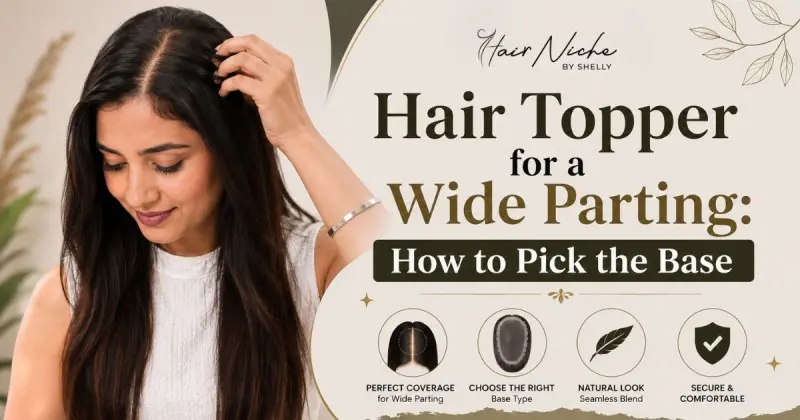
For a wide parting, choose a topper base that covers the length of your part line rather than the widest possible area. A small-to-medium silk base usually works best, because silk hides the knots and recreates a natural-looking scalp exactly where your parting is on show.
A widening part is a strange thing to watch happen. Nothing dramatic falls out. The line just gets a little broader each season, until one day the strip of scalp down the middle is the first thing you see in a photograph.
The instinct is to buy the biggest topper available. That's usually the wrong move.
Why a widening part line needs a different approach
A wide parting is a linear problem, not a circular one. The scalp shows along a line running front to back, while the hair either side of it is often still reasonably dense.
That matters because base size is usually discussed in terms of area — 5x5, 6x6, and so on. For a parting, what you actually need is enough base length to cover the part from where it starts at your hairline to where it ends, plus just enough width for the edges to rest on hair rather than skin.
An oversized base covers hair that doesn't need covering. It adds weight, sits warmer, and gives you a wider join to blend. It can also look denser than the hair around it, which draws attention to the very area you were trying to make unremarkable.
How to measure your parting
Do this in daylight, with a hand mirror behind you:
- Part your hair exactly where you normally wear it.
- Measure the length of the visible scalp line, from the hairline back to where the parting closes up.
- Measure the width at its broadest point.
- Add roughly half an inch to each figure, so the base edges land on hair.
Those two numbers are what you're shopping for. Our sibling guide on measuring for a topper covers technique in more depth if you want a second pass.
Measure on a normal hair day rather than straight after washing. Freshly washed hair sits flatter and separates more, so the parting looks wider than it usually does and you'll size up further than you need to.
Which base type suits parting coverage
For a parting specifically, the base material matters more than it does elsewhere, because the parting is the exact spot people look at.
Silk base is the strongest choice. The knots sit hidden under a fine silk layer, so the part line looks like scalp with hair growing out of it. When the parting is the problem, this is the one that solves it.
Lace base is lighter and cooler, but knots are marginally more visible along the part line — better where breathability outranks close-up realism.
Monofilament lets you move the parting, which is useful if you'd rather not commit to one line for the life of the piece.
For more on how these differ, see hair topper types.
Matching base size to how wide the parting is
Early widening — the line is broader but short. A small base focused on the part is enough. The Mini Hair Topper (Silk Base) covers the part area without the bulk of a full topper.
A defined scalp line down the part. A piece built specifically for the part line is the most efficient fit. The Scalp Line Topper targets exactly that.
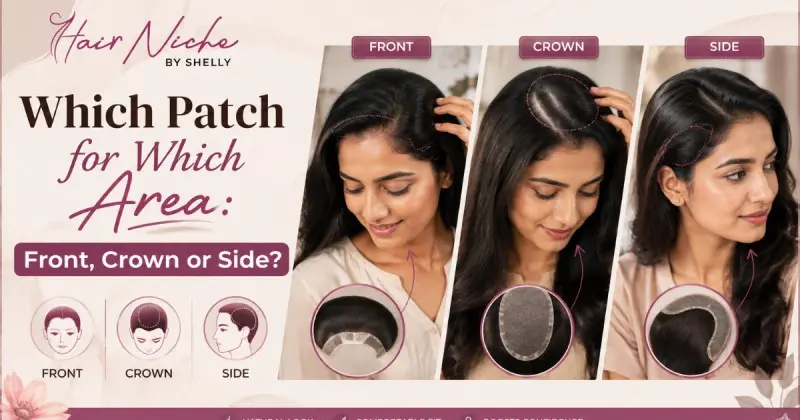
The parting has widened into the crown. Once the scalp shows either side of the line as well, you've moved past a parting problem into crown coverage, and a crown topper is the right tool. The Crown Perfect Hair Topper (Silk Base) covers the top and crown together.
Making the parting look natural once it's on
Three things do most of the work:
- Line the topper's part up with your own, so there aren't two competing partings.
- Blend a little of your own hair over the front edge — that edge is where the eye goes first.
- Vary your clip positions. The hair either side of a widening part is often the most fragile you have, so don't grip the same strands every day.
If you want to see how base size interacts with wider coverage choices, the full hair toppers range is organised by coverage area.
Cover the line, not the whole head
A wide parting needs a base long enough to cover the line and no wider than it has to be. Silk if realism at the part matters most, sized to your measurement plus a small margin — that's the whole decision.
Measure yours tonight, and if the numbers put you between two sizes, book a free consultation and we'll confirm the base and shade before you order.
FAQs
1. What size hair topper do I need for a wide parting?
Measure the length and width of the visible scalp along your part and add about half an inch to each. That gives a base whose edges rest on hair rather than skin.
2. Which topper base is best for a widening part line?
A silk base. The knots are hidden beneath a fine silk layer, so the parting looks like scalp with hair growing from it — which matters most at the exact spot people look.
3. Can a topper cover just the parting and not the crown?
Yes. Part-focused pieces and small bases cover the line without the bulk of a full topper, which is more comfortable if the hair either side is still dense.
4. My part has widened into my crown — what should I use?
Once scalp shows either side of the line, it's crown coverage rather than parting coverage. A crown topper covering the top and crown together is the better fit.
5. Will a bigger topper cover a wide parting better?
Not usually. An oversized base covers hair that doesn't need covering, adds weight and creates a wider join to blend. Size to the parting, not beyond it.
6. How do I stop the topper's parting clashing with my own?
Line the piece's part up with your natural one before you fix the clips. Two competing partings is one of the most common giveaways.
7. Will clips damage the hair beside my parting?
They can if you always attach in the same place, since that hair is often the most fragile. Vary the clip positions and clip into the fuller hair further from the line.
8. Can I change my parting while wearing a topper?
Only with a base designed for it. Monofilament bases allow a movable parting, while many silk and lace bases have a fixed part line built in.
9. Does a wide parting mean I'm going bald?
Not necessarily. A widening part is a common early sign of diffuse thinning and has several causes, some treatable, so it's worth getting assessed rather than assuming.
10. Should I measure my parting myself or get help?
You can measure it yourself with a hand mirror in daylight, but a second pair of eyes is more accurate at the back. A consultation removes the guesswork entirely.