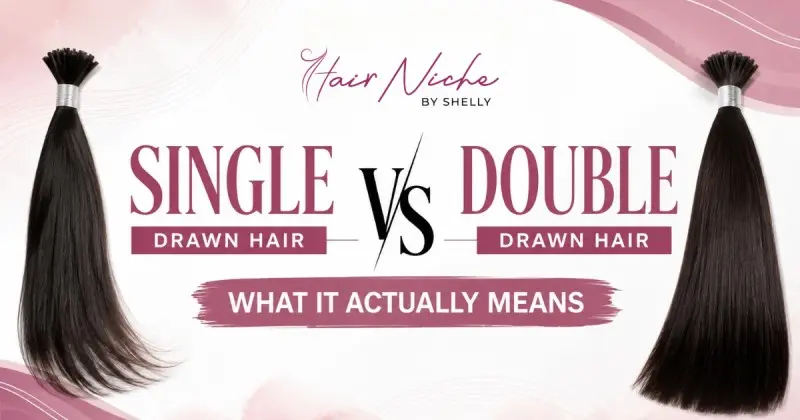
Single vs double drawn describes how uniform an extension's thickness is from root to tip. Single drawn hair keeps a mix of lengths and naturally tapered ends for an everyday, natural blend; double drawn hair has the shorter strands removed, so it stays thick and full right to the very ends. Choose single for natural, double for maximum thickness.
If you've compared extensions and seen "single drawn" and "double drawn" with a price gap between them and no real explanation, you're not alone. It's one of the most useful things to understand before buying, because it decides how thick and how natural your extensions look — and which one is right depends entirely on the look you're after.
In this guide
- What "drawn" actually means
- Single drawn hair
- Double drawn hair
- Single vs double drawn, side by side
- Which should you choose?
- Drawn vs Remy (don't confuse them)
What "drawn" actually means
Natural hair grows in a mix of lengths — even on your own head, not every strand reaches the same point. "Drawing" refers to how a bundle of extension hair is sorted by length. How much of the shorter hair is left in (or taken out) decides whether the extension tapers naturally toward the ends or stays thick all the way down.
Single drawn hair
Single drawn hair keeps most of that natural length variation. It's thicker at the top and tapers toward the ends, exactly like most people's real hair does. That makes it look the most natural and blend the most easily, it's lighter and more comfortable, and it's usually more affordable. The trade-off is thinner ends — which is a feature, not a flaw, if you want a natural everyday look. It's the go-to for anyone whose own hair is fine or medium, because the tapered ends sit seamlessly against your natural length instead of stopping in a heavy, obvious line.
Double drawn hair
Double drawn hair has the shortest strands removed by hand, so it's thick and full from root to tip with blunt, dense ends. It looks luxurious and dramatic, holds a thick blunt cut beautifully, and is ideal for big volume, sleek ponytails and updos where you don't want the ends to thin out. It's heavier and pricier because more hair (and more labour) goes into every weft. If you have naturally thick hair, double drawn matches your density so the extensions don't look thinner than your own; if your hair is fine, that same fullness can look a little heavy, so it's worth matching the drawn type to your hair, not just the shade.
Single vs double drawn, side by side
Which should you choose?
- Choose single drawn if you want the most natural result, have fine to medium hair, or prefer a lighter, comfortable everyday piece that mimics real tapered ends.
- Choose double drawn if you want maximum thickness and blunt, full ends — for dramatic length, a thick ponytail, or updos where thin ends would show.
A quick rule of thumb: if you want your extensions to look like your hair on its best day, go single drawn; if you want them to look like hair you weren't born with — noticeably thicker, fuller and longer — go double drawn. Neither is wrong; they're answering two different wishes.
Both blend best when colour-matched to your hair. Our colour-matching guide shows how, and for ponytail looks that benefit from full ends, see our clip-in ponytails.
Drawn vs Remy (don't confuse them)
These two terms describe different things and people mix them up constantly. Drawn (single/double) is about thickness uniformity — how tapered or blunt the ends are. Remy is about cuticle direction — whether the cuticles are aligned to stay smooth and tangle-free (our what is Remy hair guide explains this). A quality extension is Remy and either single or double drawn — so check both, and if a "human hair" deal looks too cheap, our how to spot fake human hair guide helps. In short: Remy decides whether it stays smooth, and drawn decides how thick the ends are — two separate promises, and a good piece keeps both.
Pick the ends that match the look you want
The whole difference comes down to the ends: single drawn tapers naturally for an everyday blend, double drawn stays thick and blunt for full-on volume. Neither is "better" — they're for different looks, and knowing which you want means you'll never overpay for thickness you didn't need, or wish you'd bought fuller ends.
Browse our real human-hair clip-in extensions, or book a free video consultation and we'll help you choose the right thickness and shade for your hair and your look.
FAQs
1. What is double drawn hair?
Double drawn hair has the shortest strands removed so it's thick and full from root to tip, with blunt, dense ends. It gives a fuller, more dramatic look than single drawn.
2. What is single drawn hair?
Single drawn hair keeps natural length variation, so it's thicker at the top and tapers toward the ends — just like most people's real hair. It looks the most natural and blends easily.
3. What's the difference between single and double drawn hair?
Single drawn tapers naturally at the ends for a natural look; double drawn stays thick and blunt to the ends for maximum volume. Double drawn is fuller, heavier and pricier.
4. Which is better, single or double drawn?
Neither is better — it depends on the look. Single drawn suits a natural everyday blend and finer hair; double drawn suits maximum thickness, blunt ends and updos.
5. Is double drawn hair worth the extra cost?
If you want thick, full ends for volume, dramatic length or updos, yes. If you want a natural, tapered look, single drawn is better value.
6. Which is more natural-looking?
Single drawn, because its tapered ends mimic how real hair naturally thins toward the bottom. Double drawn looks fuller but more uniform.
7. Is double drawn hair heavier to wear?
Yes, slightly, because there's more hair in every weft. Single drawn is lighter and can feel more comfortable for all-day wear.
8. Does single or double drawn affect blending with thin hair?
Fine or thin hair often blends more naturally with single drawn, since its tapered ends match your own. Very blunt double drawn ends can stand out on fine hair.
9. Is double drawn the same as Remy hair?
No. Double drawn refers to thickness at the ends; Remy refers to aligned cuticles that stay tangle-free. A good extension can be both Remy and double drawn.
10. Which is best for a ponytail or updo?
Double drawn, because its thick, blunt ends keep a ponytail or updo looking full instead of thinning out at the bottom.