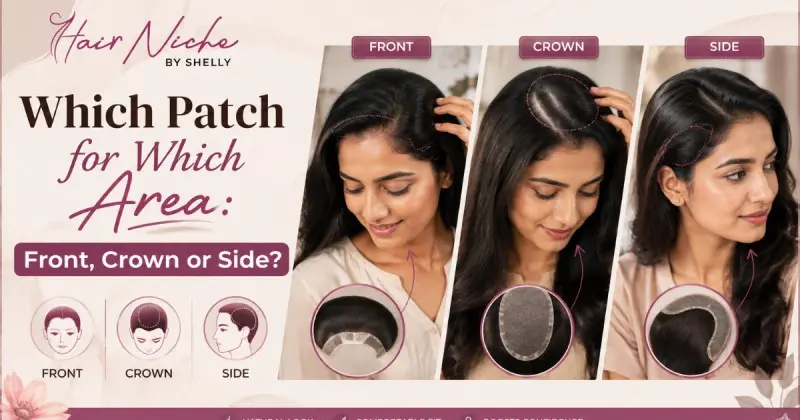
Choose a hair patch by the area you need covered. A front hairline patch fills a receding or sparse hairline, a wider cover-up patch handles crown and parting thinning, and side patches fill gaps at the temples and edges. Match the patch to the zone and it blends invisibly.
Most women don't lose hair evenly. It goes in one spot — the parting widens, the temples creep back, or the crown starts catching the light — and that one spot is all you actually want covered. Buying a piece that's too big for it feels heavy and looks obvious; too small and the thinning peeks out around the edge.
Patches solve this by covering only the zone that needs it. Here's which one belongs where.
How to work out which area you need covered
Stand under a bright light with a hand mirror and look at three places: your hairline and temples, your parting and crown, and the sides above your ears. Note where the scalp actually shows, not where you feel self-conscious — those aren't always the same place.
Most women need one zone covered. If two zones show, a hair topper covering the whole top is usually a better fit than two separate patches.
Front hairline thinning: a front patch
Thinning at the front is the most visible kind, because it frames your face in every photograph and every mirror. It often shows as a receding line, a forehead that reads broader than it used to, or baby hairs that stopped growing back.
A front patch is small and shallow, designed to sit along the hairline and restore a soft, natural edge. The Dense Front Hairline Patch is built for exactly this — a fuller front edge where the hairline has thinned.
Blend it by pulling a little of your own hair forward over the join, and part slightly to one side rather than dead centre.
Crown and parting thinning: a cover-up patch
Crown thinning is the sneaky one. You don't see it in a straight-on mirror — you notice it in a photo taken from above, or when your parting starts looking wider than it did last year.
This zone needs more surface area than a hairline patch. A cover-up patch sits over the part and crown, adding density where the scalp shows through:
- The Extra Wide Cover Up Patch suits broader crown thinning where a small piece would leave visible edges.
- The Invisible Cover up Patch suits a defined spot or a widening parting line, with a base designed to mimic the scalp.
If the thinning covers most of the top of your head rather than one patch of it, size up to a topper instead.
Side and temple thinning: side patches
Thinning at the sides — above the ears, around the temples, along the edges — is common with traction from tight styles, and it's the area patches are least often used for, simply because fewer people know side pieces exist.
Side Patches clip along the sides to fill gaps and add width back where hair has receded at the temples. They also help if you want to wear your hair tucked behind your ears again without a bare patch showing.
What all three have in common
Whichever zone you're covering, three things decide whether it looks natural:
- Colour match. Judge it against your mid-lengths in daylight, not under a bathroom bulb.
- The right size. Slightly larger than the visible thinning, so the edges rest on hair rather than skin.
- Gentle attachment. Clip into the fuller hair around the thin area, and vary the clip position rather than gripping the same fragile strands daily.
For a broader look at how patches work and how to care for them, our guide to hair patches for thinning hair covers the basics.
Cover the spot, not the whole head
The right patch is simply the one shaped for the zone that's bothering you — front for the hairline, a wider cover-up for the crown and parting, side pieces for the temples. Get the area right and you'll wear something light and forgettable instead of something that feels like a project.
If you're not certain which zone is really showing, or you're between a patch and a topper, get in touch for a free consultation and we'll help you work it out before you buy.
FAQs
1. What is a hair patch and how is it different from a topper?
A patch is a small piece that covers one localised thinning area or bald spot. A topper is larger and covers the whole top of the head, so it suits diffuse thinning rather than a single zone.
2. Which hair patch is best for a receding hairline?
A front hairline patch. It sits shallow along the hairline to rebuild a soft, natural edge, rather than adding coverage further back where you don't need it.
3. What patch should I use for crown thinning?
A cover-up patch, sized to your thinning area. Crown and parting thinning needs more surface area than a hairline piece, and the edges should rest on hair rather than scalp.
4. Are there patches for thinning at the sides or temples?
Yes. Side patches clip along the sides to fill temple gaps and restore width, which is useful if hair has receded there from tension or tight styling.
5. Can I wear more than one patch at a time?
You can, but if two areas need covering it's usually more comfortable and more natural to move up to a topper that covers the whole top in one piece.
6. How do I know what size patch to buy?
Measure the visible thinning and choose a patch slightly larger, so the edges sit on surrounding hair. Too small is the most common mistake because the thinning shows around the border.
7. Will a hair patch look natural close up?
Yes, when it's real human hair, matched to your colour, and sized correctly for the zone. A base designed to mimic the scalp is what sells it at the parting.
8. Do patches damage the hair they clip to?
Not when worn sensibly. Clip into the fuller hair around the thin area, avoid attaching to fragile strands, and change the clip position from time to time.
9. Can I style, wash and heat-treat a hair patch?
Human hair patches can be washed and heat-styled like your own hair. Use gentle products and moderate heat, and let them air dry where you can.
10. Should I choose a patch or a topper?
Choose a patch for one localised spot and a topper when the thinning spreads across the top of your head. If you're genuinely between the two, a consultation will settle it faster than guessing.