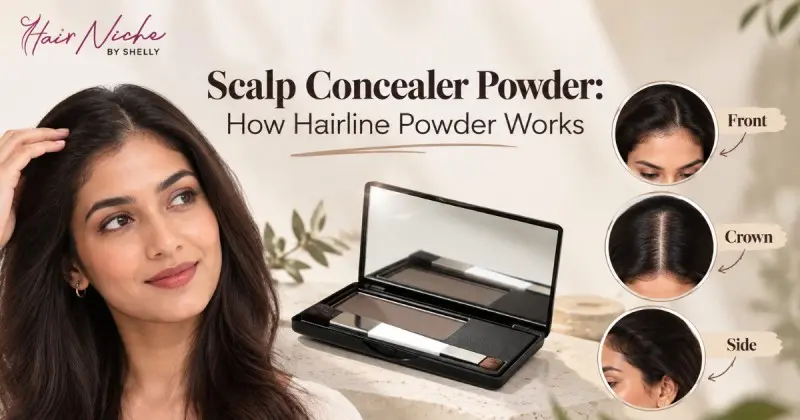
Scalp concealer powder is a tinted powder pressed onto the scalp along your parting or hairline. It works by reducing the contrast between dark hair and pale skin, so gaps stop catching the eye. It's instant and washes out, which makes it ideal for events and touch-ups rather than daily coverage.
There's a particular moment scalp powder was made for: you're dressed, you're about to leave, and the light in the hallway catches your parting in a way the bathroom mirror didn't.
Powder fixes that in about thirty seconds. It's worth knowing exactly what it does, though — and where it stops working.
How scalp concealer powder works
The reason a thinning parting is so noticeable isn't really the missing hair. It's contrast. Dark hair sitting against pale scalp creates a hard visual line, and your eye goes straight to it.
Powder doesn't add hair. It tints the scalp underneath to something closer to your hair colour, so the contrast drops and the gap stops announcing itself. Less contrast, less noticeable — that's the whole mechanism.
You press it in with a sponge or small brush rather than sweeping it, working along the parting or the hairline where skin shows most.
It's the same principle as concealer on skin. You aren't covering the gap so much as removing the shadow that makes it obvious, and at conversational distance that's usually enough.
Hair fibre powder: a different product
The two get confused constantly, so it's worth separating them.
Scalp concealer powder is a pigment. It colours the scalp to reduce contrast, and it's flat.
Hair fibre powder is made of tiny fibres that cling statically to your existing strands, thickening each one and casting small shadows. It builds apparent density rather than just tinting skin.
Fibres generally give more convincing coverage on a thinning parting. Powders are cleaner, simpler and better along a hairline where fibres can look fuzzy. Some products blend both approaches.
Where it works best
Front hairline. Softening a receded hairline or filling the corners, where you need a subtle edge rather than bulk.
The parting. Reducing the pale line down your part, especially in photographs and overhead light.
Grey regrowth. Knocking back the contrast of white roots against darker lengths between colour appointments — one of its most common uses, which our guide to covering white hair without dye covers alongside more durable options.
Small spots. A localised gap where a hairpiece would be excessive.
It's also useful alongside a hairpiece rather than instead of one. A light touch of powder where a topper's edge meets your own hair can soften the transition if your parting is very pale.
How to apply it without it looking obvious
- Start on dry, clean hair. Oil makes powder patchy and slides it around.
- Build gradually. Two light presses beat one heavy one — too much reads as flat and matte.
- Press, don't sweep. Sweeping deposits it on the hair rather than the scalp where you need it.
- Choose slightly lighter if you're between shades. Too dark looks like a shadow.
- Blend the edges so there's no visible border between treated and untreated scalp.
- Set it if you're out for long — a light mist of hairspray helps it hold.
What it genuinely can't do
Being honest about this saves disappointment:
- It won't cover a visible scalp across a wide area. Tinting a broad thinning zone reads flat in daylight. Powder reduces contrast; it doesn't create hair.
- It isn't weatherproof. Rain, sweat and swimming remove it, and it can transfer onto collars, pillows and pale clothing.
- It's temporary by design. It washes out with your next shampoo — which is the point, but it means daily reapplication.
- It does nothing for volume. Flat, fine hair still looks flat.
If the scalp is showing across your parting or crown rather than in a small gap, powder is the wrong tool. A hair topper covers the area properly and doesn't wash off in the rain — our guide to hiding thinning hair on top compares the options by how much scalp is showing.
Is it safe for daily use?
It sits on the surface and washes out, so it's generally well tolerated. Two sensible habits: wash it out rather than layering day after day, and keep the scalp underneath clean, since product build-up on skin isn't ideal for hair you're trying to protect.
If your scalp is irritated, flaky or sore, get that looked at before covering it with anything. Powder on inflamed skin can make it harder to see what's actually going on, and a scalp condition is worth treating rather than concealing.
Right tool, right job
Scalp concealer powder is genuinely useful for what it is: a fast, cheap, invisible fix for a small gap on a specific day. Judge it as an event tool and it rarely disappoints. Ask it to replace real coverage and it always will.
Not sure whether your thinning needs a cosmetic fix or actual coverage? Book a free consultation and we'll tell you honestly which one your hair needs.
FAQs
1. What is scalp concealer powder?
It's a tinted powder pressed onto the scalp along the parting or hairline. It reduces the contrast between your hair and your skin so thinning areas become far less noticeable.
2. How does hairline powder work?
It colours the visible scalp to a shade closer to your hair, so the pale line that draws the eye disappears. It doesn't add hair — it removes the contrast that makes the gap obvious.
3. What's the difference between concealer powder and hair fibres?
Powder is a pigment that tints the scalp. Fibres are tiny strands that cling to your existing hair to build apparent thickness. Fibres suit partings; powder suits hairlines.
4. Will scalp powder cover a completely visible scalp?
No. Across a broad area it looks flat in daylight. Powder reduces contrast in small gaps; visible scalp over the crown or parting needs a topper or patch.
5. Does scalp concealer powder wash out?
Yes, with your next shampoo. That's intentional, but it also means reapplying whenever you want the effect.
6. Is it waterproof?
Generally not. Rain, sweat and swimming will remove or streak it, and it can transfer onto collars and pillowcases.
7. Can I use scalp powder every day?
Many people do, but wash it out rather than layering it, and keep the scalp clean underneath. Build-up on the skin isn't ideal for hair you're trying to protect.
8. What shade should I choose?
Slightly lighter than your hair if you're between two. Too dark reads as a shadow at the parting rather than as hair.
9. Can I use it to cover grey roots?
Yes — reducing the contrast between white regrowth and darker lengths is one of its most popular uses between colour appointments.
10. Is powder better than a hair topper?
They do different jobs. Powder is an instant cosmetic for small gaps; a topper is durable coverage for a visible scalp. Choose by how much skin is showing.