To hide thinning hair on top, match the fix to how much scalp shows. Styling and a shifted parting help early thinning, a volumizer adds body when hair still covers the scalp, and a topper or patch covers skin once it's visible. Concealer powder handles small gaps instantly.
The first time you notice it is usually a photograph taken from above, or a bathroom mirror with a light directly overhead. Your parting looks wider than you remember. The crown catches the light in a way it didn't last year.
You don't need to fix it forever today. You need to know what actually covers it now — and what's just marketing.
First, work out how much scalp is showing
This one question decides everything below. Under a bright light, part your hair as you normally would and look honestly:
- Hair looks flat and fine, but no scalp shows. You need volume, not coverage.
- Scalp shows along the parting or at the crown. You need coverage.
- A distinct patch of skin is visible. You need targeted coverage over that area.
Buying volume when you needed coverage is the single most common wasted purchase. A volumizer adds body around hair — it cannot hide skin.
1. Change where you part your hair
Free, immediate, and genuinely effective in early stages. A parting worn in the same place for years leaves the hair either side trained flat and the line wide open. Move it two centimetres, or switch to a soft zig-zag, and hair falls across the gap instead of away from it.
2. Add volume at the roots
Thinning hair reads worse when it's flat against the scalp, because the skin shows straight through. Lift at the root creates shadow and makes hair look denser than it is. Blow-dry the roots in the opposite direction to how they fall, and keep heavy conditioner off the top section.
One caution: backcombing every day to build that lift does real damage over time to hair that's already fragile. Occasional teasing is fine; daily teasing at the crown is how thinning gets worse rather than better.
3. Wear a clip-in volumizer
If your hair still covers your scalp but has lost density, a volumizer adds real body in minutes — no heat, no teasing. The One Set Volumizer (4 Clips) clips in at the crown to build fullness where hair has thinned.
Worth repeating: this works while hair still covers skin. Once scalp is visible, move to the options below.
4. Use a scalp concealer powder
For small, specific gaps — a bit of scalp at the parting before an event — a concealer powder tinted to your hair colour reduces the contrast between dark hair and pale skin, so the gap stops jumping out. It's instant and washes out.
It's a cosmetic quick fix rather than a daily solution, and it won't survive rain or a swimming pool. It also works best on smaller gaps — spread across a broad thinning area it can look flat and slightly matte in strong light.
5. Cover the parting with a scalp-line topper
Once the parting itself is where the scalp shows, a piece built for that line is the most efficient answer. The Scalp Line Topper sits over the part and restores a natural-looking line, without the bulk of covering your whole crown.
If the parting has widened noticeably, our guide to choosing a hair topper for a wide parting covers base sizing for exactly that.
6. Cover a thinning crown with a patch or topper
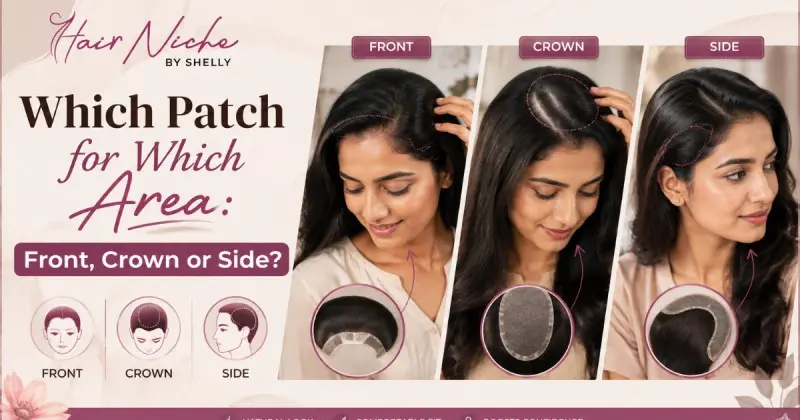
Crown thinning across a broader area needs surface, not just a line. A cover-up patch like the Extra Wide Cover Up Patch conceals a defined thinning zone at the crown.
When the thinning spreads across most of the top of your head rather than one area, a full topper is the more comfortable answer — one piece, one attachment, even coverage. The range is in hair toppers.
7. See a doctor about the cause
Covering it and understanding it are two different jobs, and they aren't in competition. Thinning on top has causes that are often treatable — thyroid issues, iron deficiency, hormonal shifts — and a GP or dermatologist can identify them with straightforward tests.
Nothing above delays that. Wear the coverage while you find out.
Match the fix to what you actually see
The reason most attempts fail is a mismatch: volume products bought for a visible scalp, or a large topper bought when a parting piece would have done. Look at how much skin is showing, choose from that, and you'll get it right the first time.
If you'd rather not judge it alone, book a free consultation and we'll look at your crown and parting with you and recommend the lightest option that works.
This article is for information only and isn't medical advice; speak to a doctor about diagnosis and treatment.
FAQs
1. How do I hide thinning hair on top of my head?
Match the method to how much scalp shows. Restyling and root volume help when hair still covers the scalp, a volumizer adds density, and a topper or patch covers skin once it's visible.
2. Will a volumizer cover a visible scalp?
No. Volumizers add fullness around existing hair but can't hide skin. If scalp is visible at your parting or crown, you need a topper or patch instead.
3. What's the quickest way to hide a thinning crown?
Scalp concealer powder is the fastest cosmetic fix for a small gap, and a clip-in piece takes only a few minutes. For daily coverage, a topper is more reliable.
4. Does changing my parting really help?
Yes, particularly early on. A long-held parting trains hair flat and leaves the line exposed, so shifting it or using a zig-zag lets hair fall across the gap.
5. What's the difference between a patch and a topper for the crown?
A patch covers one defined thinning area. A topper covers the whole top of the head, which suits thinning that has spread beyond a single zone.
6. Is scalp concealer powder safe for daily use?
It's a surface cosmetic and washes out, but it isn't designed as a permanent solution. Wash it out regularly and keep your scalp clean underneath.
7. Will hiding my thinning hair make it worse?
Not when the coverage is worn sensibly. Clip into stronger hair around the thin area, avoid constant tension in one spot, and take pieces off at night.
8. Can thinning hair on top grow back?
That depends entirely on the cause, which is why a medical opinion matters. Cover-up options conceal the appearance; they don't treat the underlying reason.
9. What causes thinning on top in women?
Common causes include hereditary pattern thinning, hormonal changes, thyroid conditions and iron deficiency. Several are treatable, so it's worth getting tested rather than guessing.
10. Should I choose coverage or see a doctor first?
Do both. Coverage restores your confidence now, and a doctor's assessment tells you whether anything can be treated — they don't work against each other.