
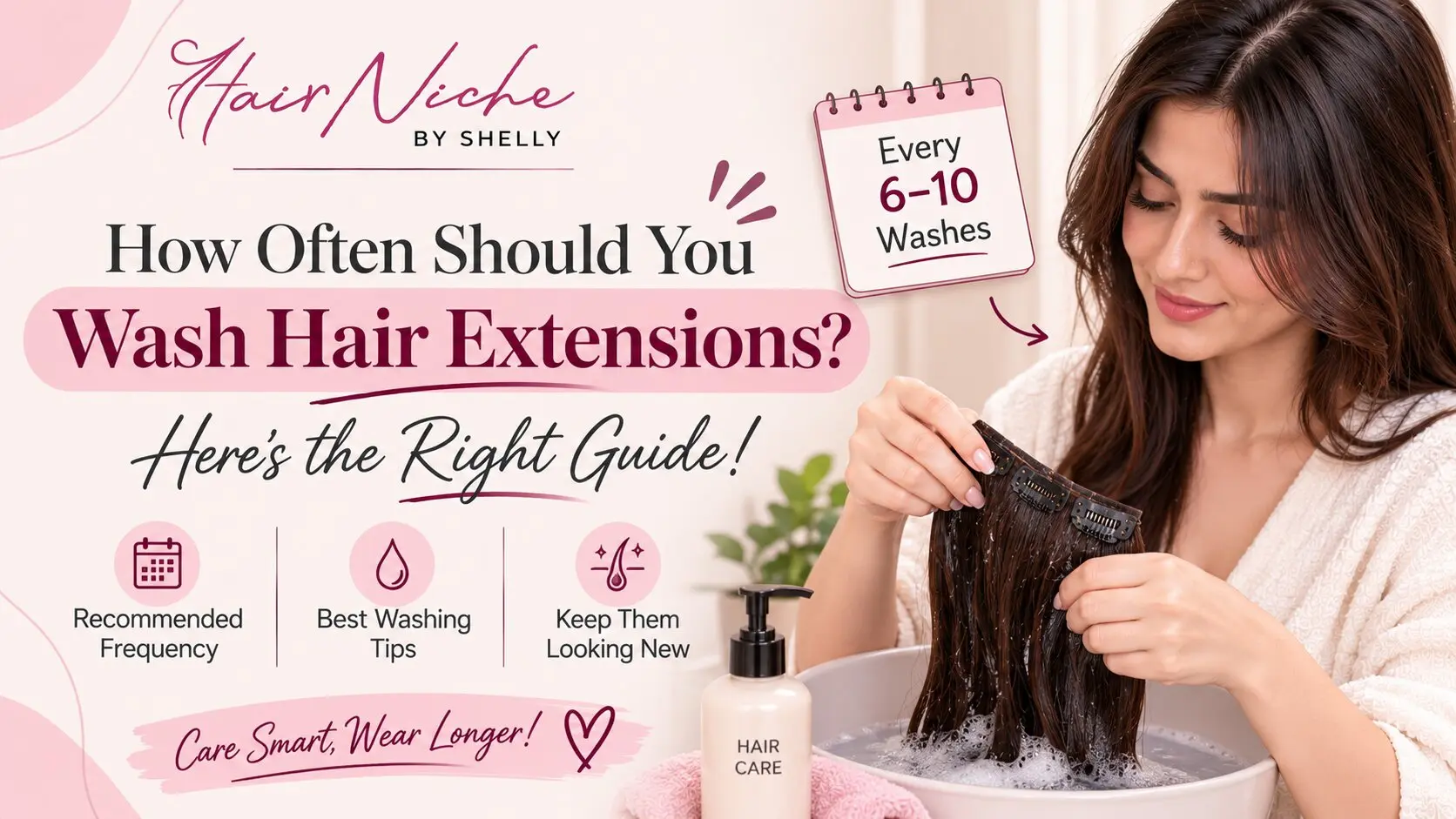
Less often than your own hair, and how much less depends on the type. Clip-ins need washing every 10 to 15 wears, bonded strands follow your normal routine because they sit at your scalp, and streaks and bun pieces go far longer.
The instinct is to wash extensions on the same schedule as your hair. That's the single fastest way to wear them out — and the reason a set that should last a year starts tangling in three months.
The right answer depends on one thing: whether the piece touches your scalp.
Why extensions need washing so rarely
Your hair gets greasy because your scalp produces oil, which travels down each strand. That's the main reason you wash it.
A clip-in weft, a bun piece or a streak never touches your scalp. No oil reaches it. It gets dirty only from product, pollution and the air — which is a far slower process.
So extensions aren't dirty on your schedule, they're dirty on their own much slower one. And because the hair can't repair itself or regrow, every unnecessary wash is permanent wear you didn't need to spend.
Washing clip-in extensions: every 10–15 wears
For clip-in wefts, volumizers and ponytail pieces, every 10 to 15 wears is the usual guide.
Adjust by how you actually wear them:
- Daily wear, products, hot weather → nearer 10
- Occasional wear, minimal product → 15 or beyond
- Heavy styling spray or serum → sooner, as build-up stiffens the hair
The real test is how they look and feel, not the count. Wash when the hair looks dull, feels heavy or has stopped moving freely. If they still look good at 20 wears, they don't need washing.
Small pieces: longer still
Streaks, bun pieces and donut scrunchies get less wear per use and carry less product than a full set.
A clip-in streak worn occasionally can go months between washes. A bun piece worn to events, similar. Washing these on a schedule is almost always unnecessary — go by appearance alone.
The exception is anything worn against a sweaty scalp in Indian summer, which needs washing sooner regardless of type. Humidity and perspiration reach a clip base even when the hair itself looks clean, so in peak summer it's worth shortening every interval on this page.
Washing bonded extensions: your own schedule
Here the logic reverses entirely.
I-tip, U-tip and flat-tip strands are attached at the root and sit against your scalp. Your scalp still produces oil, you still sweat, and you can't take them out. So bonded extensions follow your normal hair-washing routine, not a reduced one.
Two things change rather than the frequency:
What you use. Sulphate-free shampoo only, and conditioner on the mid-lengths and ends — never at the roots, where it softens bonds and loosens rings.
How you do it. Massage the scalp gently without piling the hair up, and never rub or tangle the lengths.
The semi-permanent range and its care notes are in semi-permanent extensions.
Wash frequency at a glance
Bangs sit slightly apart: they're small, but they rest against your forehead and hairline, so they pick up more oil and makeup than a weft lower down.
Over-washing extensions: what it actually costs
Every wash removes a little moisture from hair that has no way of replacing it. Repeat that weekly instead of monthly and you compress a year of wear into a few months.
The signs of over-washing look like poor quality, which is why people often blame the hair:
- Dryness at the ends that conditioning no longer fixes
- Tangling that returns immediately after detangling
- A dull, lifeless look
- Hair that won't hold a curl
If a set has started doing this, washing it more won't help — it's the cause.
Stretching the interval safely
- Store them properly between wears, so they're not picking up dust.
- Detangle after each wear, which removes most of what would otherwise build up.
- Keep heavy product off them, especially oils and thick serums.
- Rotate pieces if you own more than one — the single most effective trick.
- Spot-clean rather than full-washing when only the ends are affected.
Full washing method and care guidance is in our extension care guide, and the range is in hair extensions.
Wash by how they look, not by the calendar
That's the whole rule. Clip-ins roughly every 10 to 15 wears, small pieces far less, bonded strands on your normal schedule because they're attached to your scalp.
If you're unsure what your pieces need, book a free consultation and we'll go through it.
FAQs
1. How often should I wash clip-in hair extensions?
Roughly every 10 to 15 wears. They never touch your scalp, so they don't collect the oil your own hair does. Go by how they look and feel rather than counting strictly.
2. Can I wash extensions as often as my own hair?
No, and it's the most common mistake. Washing extensions on your own schedule removes moisture the hair can't replace and dramatically shortens their life.
3. How often should bonded extensions be washed?
On your normal hair-washing routine, because they're attached at your scalp and can't be removed. What changes is the products and technique, not the frequency.
4. How do I know when extensions need washing?
When they look dull, feel heavy with product, or stop moving freely. If they still look and feel good, they don't need washing regardless of how many wears.
5. How often should I wash clip-in bangs?
Every 15 to 20 wears is typical. They're small, but they sit against your forehead and hairline, so they pick up more oil and makeup than a weft lower down.
6. How often do hair streaks need washing?
Far less often than a full set — months, if worn occasionally. They see little wear and carry minimal product, so wash them only when they look dull.
7. What happens if I over-wash my extensions?
They dry out, tangle more easily and lose their shine and movement. The symptoms look like poor-quality hair, which is why people often blame the product instead.
8. Can I use normal shampoo on extensions?
Sulphate-free is strongly preferable. Sulphates strip moisture from hair with no scalp oils to replenish it, which accelerates dryness and tangling.
9. Should I condition the roots of bonded extensions?
No. Keep conditioner to the mid-lengths and ends, since it softens keratin bonds and makes micro rings slip at the root.
10. Does washing less make extensions last longer?
Yes, considerably. Alongside gentle heat use and proper storage, reducing unnecessary washing is the single biggest factor in how long a set lasts.