
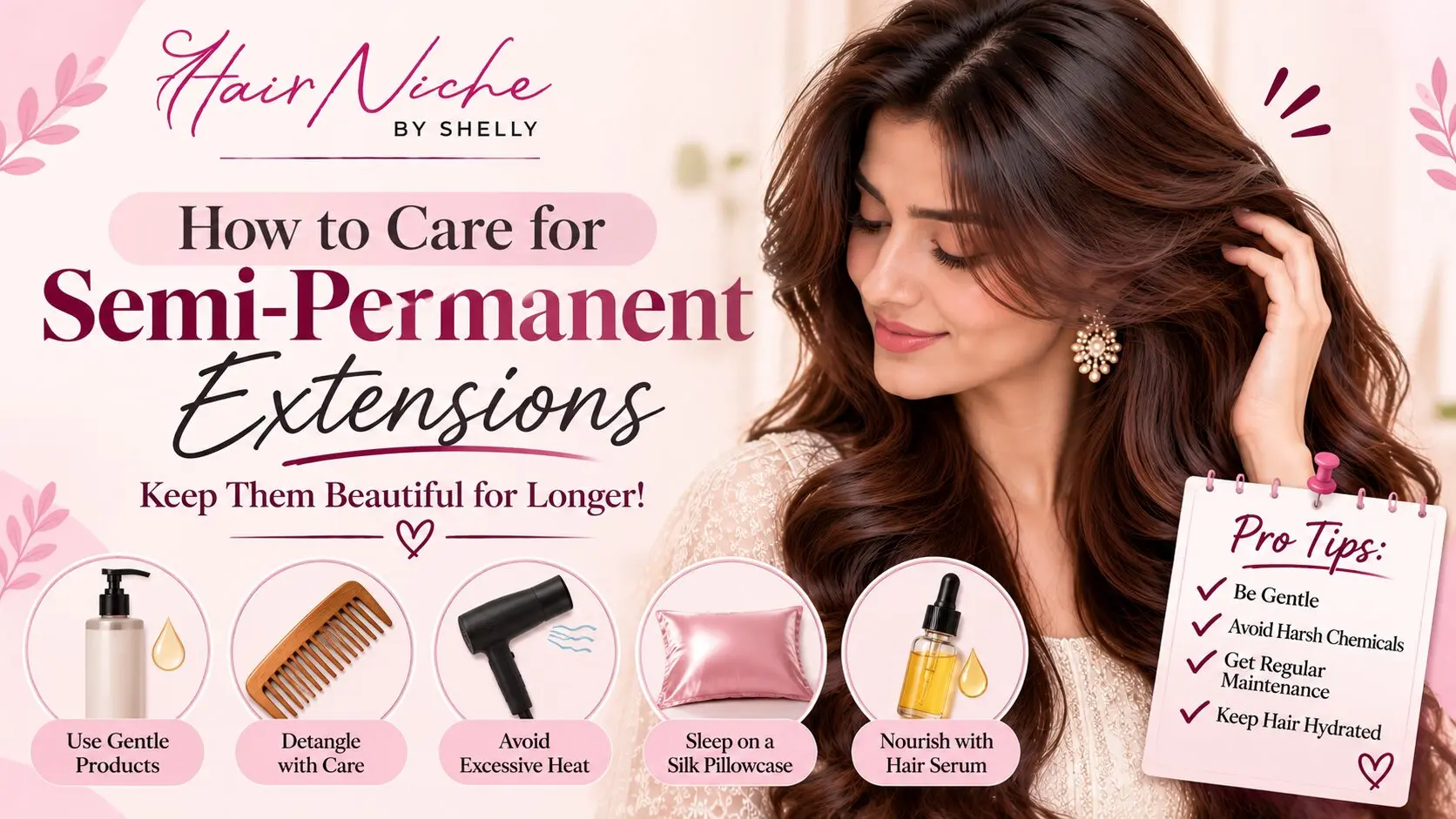
Bonded extensions can't be taken off, so the routine protects the bonds. Wash on your normal schedule with sulphate-free products, keep conditioner and oil away from the roots, brush from the ends up, braid loosely at night, and book move-ups every six to eight weeks.
Every care guide you'll find is written for clip-ins: wash the piece, dry it flat, store it in a pouch, take it off at night.
None of that applies here. Semi-permanent extensions are attached to your hair and stay there for weeks, which makes the routine a genuinely different thing — and most of it is about protecting the attachment point rather than the hair.
The principle: protect the bonds
Whether you have I-tip micro rings or U-tip and flat-tip keratin bonds, the attachment sits near your scalp and stays there between appointments.
Everything that goes wrong follows from the same few causes: anything slippery at the root loosens the attachment, anything that tugs pulls at it, and anything that tangles above it makes brushing dangerous.
Get those three right and the rest is ordinary hair care.
Washing: your normal schedule, different technique
Unlike clip-ins, bonded extensions follow your usual wash routine — your scalp still produces oil and you still need to wash it. Our guide to wash frequency by extension type covers how that differs across products.
What changes is how:
- Sulphate-free shampoo only. Sulphates dry the hair and can weaken bonds over time.
- Lukewarm water, never hot. Heat softens keratin bonds and makes rings more likely to slip.
- Wash upright, in the shower rather than head-upside-down in a basin, so the hair falls straight and doesn't tangle at the roots.
- Massage the scalp gently with fingertips. Don't pile the hair on top of your head and scrub.
- Conditioner on the mid-lengths and ends only. Never at the roots — this is the single most important rule, because conditioner softens bonds and makes rings slide.
- Rinse thoroughly. The residue at the root is as bad as the conditioner there.
Dry the roots. Going to bed with damp bonds is a reliable way to loosen them and encourage matting. Rough-dry the root area at least, even if you air dry the lengths.
Brushing: from the ends up, always
Tangling above the bond is what causes damage, because brushing through it pulls directly on the attachment.
Use a loop brush or soft-bristle brush, start at the ends, and work upward in sections. When you reach the root area, hold the hair above the bonds with your other hand so the brush pulls against your grip rather than the attachment.
Brush twice a day minimum — morning and before bed. With bonded extensions, prevention is the whole strategy; once the root area mats, it's a salon problem.
Oiling with extensions: the Indian-household question
This is the one that catches people out, and it's worth being direct.
Oil is the enemy of bonds. It softens keratin and makes micro rings slip — your own extensions category page says exactly this. Regular oiling is normal in most Indian households, and it's genuinely incompatible with bonded extensions at the roots.
If you want to keep oiling:
- Lengths only, from the mid-shaft down. Never the scalp or root area.
- Wash it out properly, with a sulphate-free clarifying wash if needed.
- Reduce the frequency while you have extensions in.
If you're not willing to change the habit — which is a perfectly reasonable position — clip-ins are the better product for you. Better to decide that now than three weeks after fitting.
Sleeping with bonded extensions
You can't take them out, so night-time matters more than with any removable piece.
- Never sleep with wet hair. Damp bonds loosen, and damp hair mats.
- Braid loosely or tie in a low, soft plait — loose enough not to pull at the roots.
- A silk or satin pillowcase reduces overnight friction considerably.
- Brush before bed, every night.
Heat, swimming and the gym
Heat styling is fine on the lengths with a protectant. Keep hot tools away from the bonds themselves — direct heat damages both keratin and rings.
Swimming is the harshest thing you can do. Chlorine and salt both degrade bonds. If you swim regularly, wet your hair with clean water first, wear a cap, and rinse immediately afterwards.
The gym is fine, but tie hair loosely rather than in a tight high ponytail, and don't leave sweat sitting at the roots.
Move-up appointments: every six to eight weeks
This is the part clip-in wearers don't have to think about.
Your hair grows, so the attachment point moves away from your scalp. As it does, the bond becomes more visible, more prone to tangling at the root, and heavier on the strand holding it.
Every six to eight weeks, a stylist removes the strands, cleans up your hair and refits them higher. With I-tip the strands can often be re-tipped and reused; with U-tip and flat-tip the bond is dissolved and the hair usually replaced.
Don't delay it. An overdue move-up is when most matting and breakage happens, and it costs more to fix than the appointment would have.
When to call your stylist
- A bond that has slipped noticeably down the strand
- Matting at the root you can't brush out
- Persistent itching, soreness or tenderness
- More than a few strands shedding at once
None of these are DIY problems. Pulling at a slipped bond is how hair gets broken.
The full range is in semi-permanent extensions.
Protect the root, and the rest follows
Sulphate-free products, nothing slippery at the roots, brush from the ends up twice a day, dry before bed, and keep the move-up appointment. That's the whole routine, and it's what decides whether extensions last well or become a problem.
If you're considering bonded extensions and unsure whether the routine fits your life, book a free consultation — it's worth an honest conversation before fitting rather than after.
FAQs
1. How do I care for semi-permanent hair extensions?
Wash on your normal schedule with sulphate-free products and lukewarm water, keep conditioner and oil away from the roots, brush from the ends upward twice daily, dry the roots before bed, and book move-ups every six to eight weeks.
2. Can I oil my hair with bonded extensions?
Not at the roots. Oil softens keratin bonds and makes micro rings slip. Keep oil to the lengths only, wash it out thoroughly, and reduce the frequency while extensions are in.
3. Why shouldn't the conditioner go near the roots?
The conditioner is designed to make hair slippery, which is exactly what loosens a bond or ring. Keep it to the mid-lengths and ends and rinse thoroughly.
4. How often do semi-permanent extensions need a move-up?
Every six to eight weeks. As your hair grows the attachment moves away from the scalp, becoming more visible and more prone to tangling. Delaying causes most matting problems.
5. Can I sleep normally with bonded extensions?
Yes, with precautions — never sleep on wet hair, braid or tie loosely, use a silk or satin pillowcase, and brush before bed to prevent overnight matting.
6. How should I brush bonded extensions?
With a loop or soft-bristle brush, from the ends upward in sections. At the root, hold the hair above the bonds so the brush pulls against your hand rather than the attachment.
7. Can I swim with semi-permanent extensions?
You can, but chlorine and salt degrade bonds. Wet your hair with clean water first, wear a cap, and rinse thoroughly immediately after swimming.
8. Can I use heat tools on bonded extensions?
On the lengths, yes, with a heat protectant. Keep hot tools away from the bonds themselves, since direct heat damages both keratin bonds and micro rings.
9. What if a bond slips?
See your stylist rather than pulling at it. A slipped bond can usually be refitted, but tugging at it is how hair gets broken.
10. Are bonded extensions harder to maintain than clip-ins?
They need more discipline, because you can't take them off. Clip-ins involve more daily effort to put on, but far fewer restrictions on washing, oiling and sleeping.