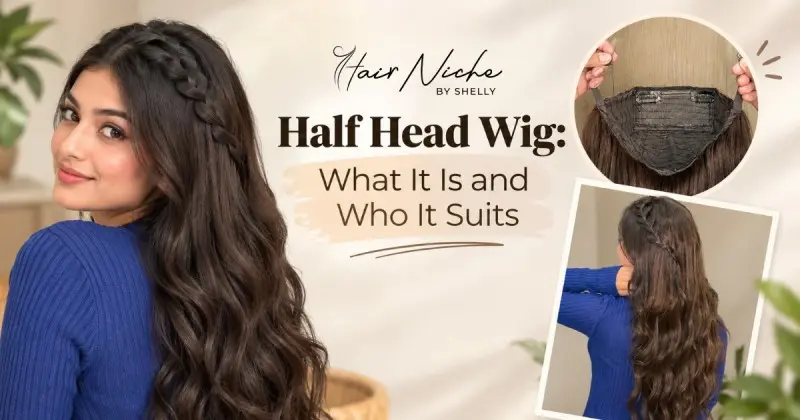
A half head wig covers the back and crown of your head while your own hair at the front and sides stays out and visible. Because your real hairline does the blending, it looks natural without lace or adhesive — and it suits women whose thinning sits behind rather than at the front.
Somewhere between a topper and a full wig sits a piece a lot of women don't know exists. It covers more than a topper, far less than a wig, and it relies on something you already have: your own front hairline.
If your thinning is at the back and crown while your hairline is still fine, this is very likely the piece you've been looking for.
What a half head wig actually is
A half head wig covers roughly the back half of your head — the crown, the back and partway down — while the front section of your own hair is left out and combed over the join.
That leave-out is the clever part. The most difficult thing to fake on any wig is a natural hairline, which is why lace fronts exist and why they cost what they do. A half head wig sidesteps the problem entirely: your real hairline is your hairline.
It's sometimes called a partial wig, and it attaches with clips or combs rather than glue.
It also solves a problem toppers can't. A topper covers the top of your head, but if your hair is thin all the way down the back as well, a topper leaves that length looking sparse underneath. A half head wig brings coverage and length together.
Who a half wig for women suits
You're a good candidate if:
- Your thinning is at the back and crown, with a reasonably intact front hairline
- You want more coverage than a topper provides but don't need a full wig
- You want length and volume together, not just coverage
- You'd rather not deal with lace, adhesive or a full cap
- You want something quick to put on and take off
You're probably not a candidate if your hairline itself has receded, or if the thinning is diffuse across the whole head including the front — at that point the leave-out won't have enough hair to blend with, and a full wig is the better answer.
Wig with own hair out: how the blend works
The blend lives or dies on the leave-out. Three things make it convincing:
Texture match. Your own front hair is on show right beside the piece, so the wave pattern needs to agree. Straight leave-out against wavy wig hair is the most common giveaway.
Colour match. Judge it in daylight against your mid-lengths, not your roots.
Enough leave-out — but not too much. Too little and the join shows; too much and the front looks thin against the fullness behind. A small, even section across the front is the target.
The Half Head Wig (Natural Brown) and Half Head Wig (Natural Black) are made for exactly this blend, adding fullness at the crown and back while your front hair carries the hairline.
Half head wig as an alternative to full wig
If your loss is extensive enough that a leave-out isn't realistic, a full wig such as the Silk Base Full Head Wig gives complete coverage with a realistic scalp. The whole range sits in human hair wigs.
Wearing one comfortably
- Flatten the hair underneath. A smooth base stops bumps showing through.
- Secure the clips into stronger hair, not the thinnest sections.
- Vary the clip positions so no single area takes daily tension.
- Blend the leave-out over the join — brush the two together rather than leaving a visible line.
- Take it off at night so your scalp gets air.
If you're weighing this against a topper, the deciding question is how far the thinning extends: toppers cover the top, half wigs cover the back and crown as well. Our guide to thinning at the back of your head covers that area in detail.
The piece between a topper and a wig
A half head wig gives you real coverage without giving up your own hairline — which is why women who've hesitated over full wigs often find it's the thing that finally works. Match the texture, get the leave-out right, and the join simply isn't visible.
Not sure whether your front hair is enough to blend with? Book a free consultation and we'll look at your hairline and tell you honestly whether a half wig or a full wig fits.
FAQs
1. What is a half head wig?
It's a wig covering roughly the back half of your head — crown and back — while your own front hair is left out and blended over the join, so your natural hairline stays visible.
2. Who should wear a half wig?
Women with thinning at the back and crown who still have a reasonably intact front hairline, and who want more coverage than a topper without moving to a full wig.
3. How does a half head wig blend with my own hair?
Your front section is left out and combed over the join. Matching the texture and colour of that leave-out to the piece is what makes the transition invisible.
4. Is a half wig better than a full wig?
Neither is better — they suit different amounts of loss. A half wig works when your hairline is intact; a full wig is right when thinning is extensive or the front has receded.
5. Do half head wigs need glue or lace?
No. They attach with clips or combs, and because your own hairline is on show there's no need for lace or adhesive at the front.
6. Can I wear a half wig if my hairline is receding?
Usually not well, because the leave-out won't have enough hair to blend. A front hairline piece or a full wig with a lace front is the better fit.
7. How much hair should I leave out?
A small, even section across the front — enough to cover the join without looking sparse against the fullness behind. Too much leave-out makes the front look thin.
8. Are half head wigs comfortable in Indian heat?
They're generally cooler than full wigs because less of your scalp is covered, and your own front hair stays exposed rather than under a cap.
9. Will a half wig damage my hair?
Not when worn sensibly. Clip into stronger sections, vary the positions rather than gripping the same hair daily, and remove it at night.
10. Can I style a half head wig?
Human hair half wigs can be curled, straightened and restyled. It's worth styling the piece and your leave-out together so they move as one.