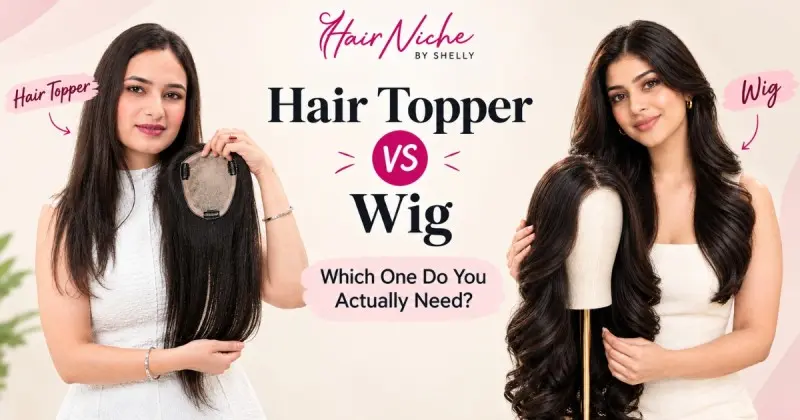
The difference between a hair topper and a wig is coverage. A topper covers only the top of your head and blends with the hair you still have. A wig covers your whole head and replaces it. The deciding question: do you have enough hair left for a topper to blend into?
Most women arrive at this comparison after weeks of research, having read plenty about both and still not knowing which applies to them.
It comes down to one thing, and it isn't how much thinning bothers you. It's how much hair you have left around it.
The difference between topper and wig
A hair topper is a partial piece. It has a base — silk, lace or monofilament — that sits over the thinning area on top of your head, with clips that grip your existing hair. Your own hair at the sides and back stays out, and blends around the edges of the piece.
A wig covers your entire head. It replaces your hair rather than supplementing it, usually with a cap that sits over everything, often with a lace front to create a hairline.
That's the whole structural difference, and every other difference follows from it.
Partial vs full coverage: what actually changes
A topper needs your hair; a wig doesn't. This is the crucial one. A topper's edges have to rest on surrounding hair to disappear. If there isn't enough hair around the thinning, those edges show, and no amount of colour matching fixes it.
Weight and heat. A topper covers a small area and leaves most of your scalp exposed, so it's lighter and considerably cooler — a real factor through an Indian summer. A wig covers everything, which is warmer by nature.
Your own hairline. With a topper, the hairline is yours, so there's nothing to fake. A wig has to create one, which is why lace fronts exist and why they need more care to look right.
Time. A topper clips in within a couple of minutes. A wig takes longer to position and secure properly.
Styling. With a topper you're styling your hair and the piece together. With a wig you're styling the wig.
Which one do you need?
The middle rows are where most confusion sits. If your thinning covers most of the top of your head but your sides and back are healthy, you don't need a wig yet — you need a larger topper. The Premium Full Head Topper covers a broad top area while still blending into your own hair.
And if the thinning runs down the back as well as the crown, our guide to the half head wig covers the option that sits between the two.
When to switch to a wig
Some women start with a topper and move to a wig later. These are the honest signals it's time:
- The topper's edges have started showing. As surrounding hair thins, there's less to conceal the border. If you're constantly adjusting it, it's outgrown its usefulness.
- The clips won't hold. When there isn't enough hair to grip, you're either clipping too tight — which damages what's left — or the piece slides.
- You've sized up more than once. Each time you need a bigger base, you're moving toward full coverage anyway.
- The sides and back have thinned too. A topper only solves the top. Once the whole head is affected, it's covering a fraction of the problem.
Switching isn't a defeat. A well-matched wig such as the Silk Base Full Head Wig, with its realistic scalp appearance, is often a relief after months of managing a topper that's no longer working — and a shorter bob-cut style is worth considering if you want lower daily upkeep.
Can you wear both?
Yes, and many women do. A topper for everyday wear when it still blends well, and a wig for long days, events, or times when the thinning feels more exposed.
They're not competing purchases so much as different tools, and having both means you're never stuck with the wrong one for the occasion.
Start with the hair you have
Forget which sounds better and look at what's actually on your head. Hair around the thinning means a topper will work and will be lighter, cooler and faster. Not enough hair to blend into means a wig, and no topper will fix that.
If you're genuinely on the line — and plenty of women are — book a free consultation and we'll look at your hair and tell you honestly which one fits. New to toppers entirely? Browse our full range of hair toppers.
FAQs
1. What is the difference between a hair topper and a wig?
A topper covers only the top of your head and blends with the hair you still have. A wig covers your whole head and replaces your hair, so it doesn't need surrounding hair to look natural.
2. Should I get a hair topper or a wig?
Choose a topper if you have healthy hair at the sides and back for it to blend into. Choose a wig if thinning is spread across your whole head or there's too little hair for clips to hold.
3. Is a hair topper more comfortable than a wig?
Generally yes. A topper covers a smaller area and leaves most of your scalp exposed, so it's lighter and cooler, which matters in hot weather.
4. Can a hair topper cover the whole top of my head?
Yes, larger full-top toppers cover a broad area while still blending into the hair at your sides and back. You only need a wig once that surrounding hair thins too.
5. When should I switch from a topper to a wig?
When the edges start showing, the clips won't hold, you've sized up repeatedly, or the sides and back have thinned. Those all mean the topper no longer has enough hair to blend with.
6. Does a topper or a wig look more natural?
A topper has a natural advantage because your own hairline is real. A good lace-front wig also looks very natural, but the hairline has to be created rather than being yours.
7. Is a wig hotter to wear than a topper?
Yes, because it covers your whole scalp. Choosing a breathable cap helps, but a topper will always be cooler simply because less of your head is covered.
8. Can I wear a topper if I have very little hair?
Only if there's enough hair for the clips to grip and for the edges to blend into. With very sparse hair, a wig gives a better and more secure result.
9. Which lasts longer, a topper or a wig?
Lifespan depends far more on hair quality and care than on the type. Both last considerably longer when washed gently, heat-styled moderately and stored properly.
10. Can I own both a topper and a wig?
Yes, and many women do — a topper for everyday wear and a wig for long days or events. They suit different situations rather than competing.