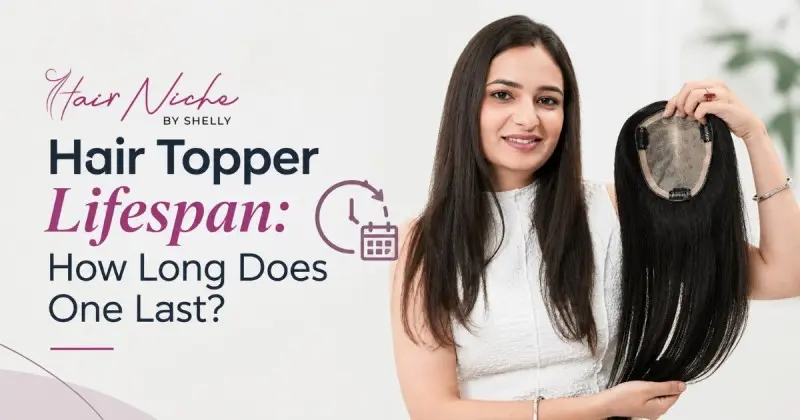
A human hair topper typically lasts somewhere between six months and two years. The spread is that wide because lifespan depends far more on how often you wash it, how much heat you use and how you store it than on the piece itself. Care, not cost, decides it.
It's a fair question to ask before buying something you'll wear most days, and most answers give you a range so broad it isn't much help.
The range is honest, though. What it's really telling you is that the topper's lifespan is largely in your hands — which is better news than a fixed number would be.
How long does a hair topper last, realistically
Think in terms of wear, not calendar months.
A topper worn occasionally — for events, or on days you want more volume — can stay in good condition for a couple of years. The same topper worn every day, washed weekly and heat-styled each morning may need replacing within six to nine months.
Neither is a defect. It's simply that a hairpiece has a finite amount of hair, and unlike your own hair, nothing replaces what's lost.
It's worth setting expectations against how you'll actually wear it. If a topper is going to be part of getting dressed every morning, budget for replacing it sooner and treat that as the running cost of wearing one — the same way you would with anything worn daily.
The one thing that makes toppers different from your hair
Your scalp produces oil that travels down each strand, and your hair grows, so damage eventually gets trimmed away.
A topper has neither. Every wash, every pass of a straightener and every bit of friction is cumulative and permanent. That single fact explains every care instruction you'll ever read about hairpieces — they're all attempts to slow an accumulation that can't be reversed.
What shortens a topper's life
Washing too often. The most common cause by far. A topper doesn't collect scalp oil, so it doesn't need washing on your hair's schedule. Many women wash weekly out of habit and halve the life of the piece.
Heat. Daily straightening or curling at high temperature dries the hair out faster than anything else you do to it.
Friction. Bag straps, collars, seatbelts and rough brushing wear at the ends. Long pieces suffer most.
Bad storage. Stuffed in a drawer, the hair tangles and the base loses shape.
Harsh products. Sulfates strip hair that has no way of replenishing itself.
Sun and swimming. Prolonged UV exposure dulls and dries the hair, and chlorine and salt water are harsher on a hairpiece than on growing hair. Neither rules out a holiday, but both are worth planning around.
How to extend topper life
- Wash it only when it needs it — when it looks dull or feels heavy with product, not on a schedule. For many women that's every eight to ten wears.
- Use sulfate-free shampoo and condition generously. You're replacing moisture the scalp would normally supply.
- Detangle from the ends upward with a wide-tooth comb or loop brush, gently, never from the roots down.
- Keep heat low and use protection. Moderate settings, and skip heat entirely on days you don't need it.
- Air dry on a stand so the base keeps its shape, rather than rough-towelling.
- Store it on a stand or in a soft pouch, never crushed.
- Take it off at night. Sleeping in a piece is the fastest route to matting.
Done consistently, these roughly double what you'd get from careless wear — which is a far bigger difference than choosing a pricier piece.
Does base type affect lifespan?
To a degree. Very fine lace is the most delicate component of any hairpiece, and it's usually the base — not the hair — that fails first on a heavily worn piece. A Seamless Lace Hair Topper is light and breathable but asks for gentler handling, while a silk-base piece like the Essential Hair Topper (Silk Base) is a little more robust at the parting.
That said, handling matters more than construction. A carefully worn lace piece outlasts a roughly treated silk one every time.
When to replace a hair topper
The signals are usually clear:
- Persistent tangling that conditioning no longer fixes
- Dryness at the ends that doesn't recover after a treatment
- Visible thinning of the piece itself, particularly near the parting
- Clips that no longer hold, or a base that's stretched or torn
- Colour that's drifted warmer or duller than your own hair
A common approach is to keep an older piece for casual days and a newer one for work and occasions, which stretches both — and means you're never without one while a replacement is on its way.
Care is the variable, not the price tag
The honest answer to "how long will it last" is: longer than you'd expect if you wash it rarely, heat it gently and store it properly — and considerably less if you treat it like your own hair.
If you'd like help choosing a piece suited to daily wear rather than occasional use, book a free consultation, or browse the full range of hair toppers.
FAQs
1. long does a hair topper last?
Typically six months to two years. The range is wide because wash frequency, heat use and storage affect lifespan far more than the piece itself does.
2. Why do hair toppers wear out faster than my own hair?
Because there's no scalp feeding them oil and no growth replacing damage. Every wash, heat styling session and bit of friction is permanent and cumulative.
3. How often should I wash a hair topper?
Far less often than your own hair — commonly every eight to ten wears, or when it looks dull or feels product-heavy. Over-washing is the most common reason toppers wear out early.
4. Does heat styling shorten a topper's life?
Yes, significantly. Daily high-heat styling dries the hair faster than anything else. Use moderate temperatures, always with heat protection, and skip heat when you can.
5. How should I store a hair topper?
On a stand or mannequin head, or in a soft pouch. Storing it crushed in a drawer causes tangling and distorts the base.
6. Can I sleep in a hair topper?
It's best not to. Overnight friction mats the hair quickly and stresses the clips, which is one of the fastest ways to shorten the piece's life.
7. Does a more expensive topper last longer?
Not automatically. Quality hair helps, but care is the bigger variable — a well-maintained mid-range piece routinely outlasts a neglected premium one.
8. How do I know when to replace my topper?
When tangling persists despite conditioning, the ends stay dry after treatment, the piece looks visibly thinner, or the base and clips no longer hold securely.
9. Does the base type affect how long a topper lasts?
Somewhat. Fine lace is the most delicate part and often fails before the hair does, while silk is a little more robust. Handling still matters more than construction.
10. Can a worn topper be refreshed instead of replaced?
A deep conditioning treatment and a professional trim can revive a tired piece, and re-toning can correct drifted colour. Once the base is damaged, replacement is usually the better option.