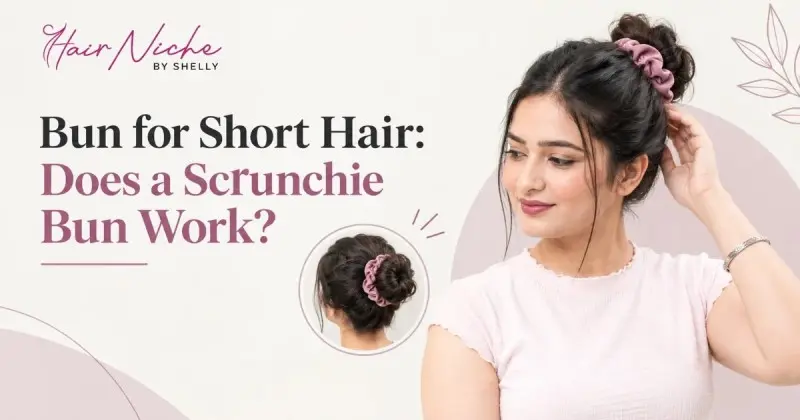
A scrunchie bun works on short hair if you can gather it into a ponytail — roughly chin length or longer. Below that there isn't enough to wrap, and the bun won't hold. For shorter hair, a clip-on bun attaches to a small section and works regardless of length.
Short hair is wonderful right up to the moment you want it off your neck. Then you discover that every bun tutorial online quietly assumes you have at least shoulder-length hair to work with.
So here's the straight answer about what works at what length, including the point where the honest answer is "this one won't."
What length do you actually need for a bun?
The test isn't really length — it's whether you can gather your hair into a ponytail that stays put.
Chin length or longer: you can usually manage a small bun, especially at the nape where hair is longest.
Jaw length: borderline. A tiny bun may hold with pins, but shorter layers will escape all day.
Above the jaw, or a pixie: a bun from your own hair isn't realistic. Not a styling failure — there simply isn't enough hair to wrap.
Layers complicate all of this. Even reasonable overall length won't bun neatly if the top layers are much shorter, which is why many women with graduated bobs find their hair "won't" go up.
Texture matters too. Thick, coarse short hair holds a small bun far better than fine, silky short hair of the same length, which tends to slip out no matter how many pins you use.
Scrunchie bun short hair: when it works
A hair scrunchie bun — wrapping a hairpiece scrunchie around your own small bun or ponytail — works well if you can form that base, even a modest one.
It's genuinely useful on short hair because your own bun only has to be small. The scrunchie adds the bulk, so a thin little knot becomes a full, rounded shape. If you've tried a bun and found it disappointingly tiny, this is the fix.
What it can't do is create a base that isn't there. If your hair won't hold a ponytail, a wrap-around scrunchie has nothing to wrap around.
Clip on bun for short hair: when the scrunchie won't work
This is the option most women with short hair don't know exists.
A clip-on bun attaches with a clip to a small section of your own hair, rather than wrapping around a ponytail. Because it brings its own structure, it doesn't need length — just somewhere to grip.
The ClipNGO Bun works this way, in natural brown, with a natural black version too. Clip it in, position it, and you have a bun that short hair couldn't otherwise produce.
It's also the quickest option by some distance, which matters if you're doing this before work rather than before a wedding.
How to bun short hair: practical tips
- Add grip first. Clean, slippery hair is the enemy. A little texturising spray or dry shampoo gives short hair something to hold.
- Go low. The nape is where your hair is longest, so a low bun is far more achievable than a high one.
- Pin from underneath. Push pins up into the bun against the direction of pull, rather than stabbing downward.
- Let the front pieces go. Short layers around the face will escape. Pulling them out deliberately looks intentional; fighting them doesn't.
- Work with second-day hair. Freshly washed short hair is at its most slippery, so a bun holds far better a day after washing.
- Secure the base properly before adding any piece. A wobbly base makes everything above it wobble.
Choosing a piece that matches
Whichever route you take, two things make it convincing: colour matched to your mid-lengths in daylight, and a size that suits your head and your hair. An oversized bun on a short, fine head of hair reads as added — a modest one simply reads as a bun.
The full range, including donut scrunchies and messy bun pieces in several shades, is in our buns and scrunchies collection. If you're also after length and body more generally, our guide to hair extensions for short hair covers that.
Short hair doesn't rule out a bun
It rules out one method. If you can make a ponytail, a scrunchie bun will give you the fullness your own hair can't. If you can't, a clip-on bun does the whole job regardless of length.
Not sure which suits your length? Book a free consultation and we'll match a piece to your hair and shade.
FAQs
1. Can you do a bun with short hair?
Yes, if you can gather your hair into a ponytail — roughly chin length or longer. Below that, a clip-on bun attaches to a small section and gives you a bun without needing length.
2. What length hair do you need for a bun?
Chin length is the usual minimum for your own hair to form a bun. Jaw length is borderline, and above the jaw a bun from your own hair isn't realistic.
3. Does a scrunchie bun work on short hair?
It works if you can form a small ponytail or bun for it to wrap around. The scrunchie adds the bulk, so even a modest base becomes a full, rounded bun.
4. What's the difference between a scrunchie bun and a clip-on bun?
A scrunchie bun wraps around your own bun and needs a base to work with. A clip-on bun clips to a small section and brings its own structure, so it works on much shorter hair.
5. Why won't my short hair stay in a bun?
Usually too-short layers escaping, or hair that's too clean and slippery to grip. Texturising spray helps, and pinning upward from underneath holds better than pinning down.
6. Can I wear a bun with a pixie cut?
Not from your own hair, but a clip-on bun can attach to a small section and create the look. It's the main option at that length.
7. How do I make a small bun look fuller?
Wrap a hairpiece scrunchie around it, which adds bulk without needing extra length of your own. It's the most common reason women buy one.
8. Will a bun piece look obvious on short hair?
Not if it's matched to your colour and sized sensibly. An oversized bun on fine or short hair is what looks added — a modest, well-matched one doesn't.
9. Do clip-on buns damage short hair?
Not when worn sensibly. They clip to a small section and carry their own weight, so vary the position between wears and remove the piece at night.
10. Can I do a bun if my hair is layered?
It's harder, because shorter top layers escape. Work low at the nape, add grip with product, and accept some face-framing pieces staying out.