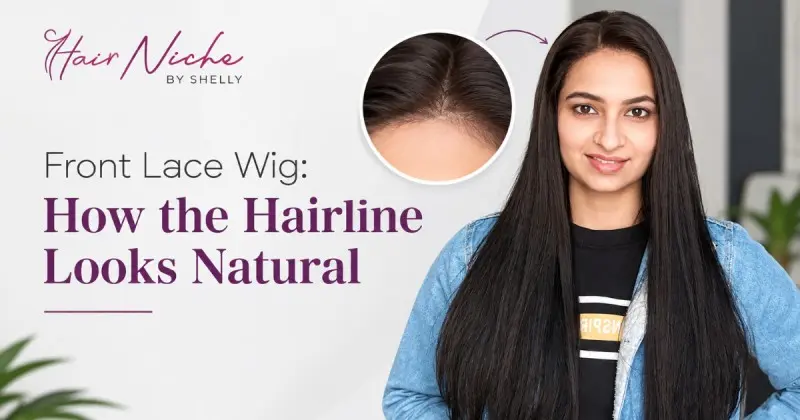
A front lace wig has a sheer lace panel along the front edge with hairs hand-tied into it individually. Because the lace is fine and skin-toned, it disappears against your forehead, so the hair appears to grow from your scalp rather than starting at a visible wig edge.
The hairline is the only part of a wig that most people ever scrutinise. Everything else — the length, the colour, the density — reads as hair. The front edge is where a wig either convinces or announces itself.
That's the single problem lace fronts were invented to solve, and it's worth understanding how before you buy one.
Why the hairline is the giveaway
On a wig without lace, the hair begins at a fabric edge. However well made, that edge is a line: hair on one side, forehead on the other, with nothing in between.
Real hairlines don't work like that. They're irregular, slightly sparse at the very front, and they fade rather than start. Anything that creates a hard boundary across the forehead reads as "wig" instantly, even from a distance.
How lace front wigs work
A front lace wig replaces that hard edge with a panel of very fine, sheer lace. Individual hairs are hand-tied through the holes in the mesh, one or two at a time.
Two things follow. First, the lace is thin and neutral enough to sit almost invisibly against the skin. Second, because hairs are tied individually rather than sewn in rows, the front can be made deliberately irregular — slightly thinner at the edge, denser further back — which is how real hair grows.
The result is a transition rather than a line. The Front Lace Full Head Wig is built this way.
Lace front and seamless hairline: what's the difference
Not every natural-looking hairline uses lace. A seamless front hairline wig achieves a similar effect through construction at the front edge, designed to sit flush and blend without a separate lace panel.
Practically, the difference matters for upkeep. Lace is fine and needs gentler handling, particularly when washing and storing. A seamless front like the Seamless Front Hairline Wig is more forgiving day to day, which suits daily wear.
Neither is better in the abstract. Lace gives the most convincing close-up front; seamless is sturdier for everyday life.
What makes a natural wig hairline convincing
Four things, in order of how much they matter:
Placement. Most unconvincing wigs are simply sitting too far forward. Your natural hairline is further back than you think — roughly four fingers above your eyebrows for most people. Position the wig there, not at the edge of your forehead.
Density at the front. A hairline that's as dense as the mid-lengths looks wrong, because real hairlines are finer at the edge. Good wigs are made this way already.
Lace that matches your skin. Lace is made in a few neutral tones. Against very different skin it can read slightly pale. A touch of powder along the parting tones it down if needed.
Your own hair underneath. Bumps and lumps under the cap lift the front edge away from your head. Flatten or braid your hair first — it does more for realism than any product.
Wearing it so the front stays flat
The front edge lifting is the most common day-to-day problem, and it's usually mechanical rather than a fault in the wig.
Secure the wig at the nape and sides first, then settle the front last, so the lace sits flat rather than being pulled taut. Avoid pushing the wig back off your forehead through the day — that's what breaks the line. And when you take it off, lift from the back, never by pulling the front edge.
Our post on common wig mistakes covers the fit and sizing errors that cause most hairline problems.
Caring for the lace
The lace is the most delicate part of the wig and the part that fails first. Three habits extend it considerably:
- Handle the front edge as little as possible. Every adjustment stresses the mesh.
- Wash gently, supporting the front rather than scrubbing it, and let the wig dry on a stand so the front keeps its shape.
- Store it on a stand or in a soft bag, never folded with the front creased.
Treated this way, the hairline stays convincing for the life of the wig rather than for the first few months.
The hairline is the whole illusion
A front lace wig works because it replaces a hard edge with a gradual one. Place it where your real hairline sits, keep the hair underneath flat, handle the lace gently — and nobody looks twice.
Not sure whether lace or a seamless front suits your routine better? Book a free consultation and we'll match the construction, length and shade to how you actually live. Or browse the full range of human hair wigs.
FAQs
1. What is a front lace wig?
It's a wig with a sheer lace panel along the front edge, with hairs hand-tied into the mesh individually. The lace sits almost invisibly against the skin so the hair appears to grow from your scalp.
2. How does a lace front make the hairline look natural?
It replaces the hard edge of a standard wig with a gradual transition. Because hairs are tied individually, the front can be made finer at the edge and denser behind, which mimics real growth.
3. Do I need glue for a front lace wig?
Not for a ready-to-wear wig like ours, which secures with its built-in clips, combs and adjustable straps. Adhesive belongs to custom install routines rather than everyday wear.
4. What's the difference between a lace front and a seamless hairline wig?
A lace front uses a separate sheer panel for maximum close-up realism. A seamless front achieves a flush blend through its construction and is generally sturdier for daily wear.
5. Where should a wig hairline sit on my forehead?
Roughly four fingers above your eyebrows for most people. Placing the wig too far forward is the most common reason a hairline looks wrong.
6. Why does the front of my wig lift up?
Usually because your own hair isn't flat underneath, the wig is positioned too far forward, or the front was pulled taut when fitting. Secure the back and sides first, then settle the front.
7. Can I part a front lace wig differently?
A lace front allows some flexibility at the front edge, though how freely you can part depends on the construction. A mono base gives the most parting freedom.
8. How long does the lace last?
It depends almost entirely on handling. Minimising adjustments to the front edge, washing gently and storing on a stand all extend the lace well beyond careless use.
9. Will a lace front wig look natural in photographs?
Yes, when it's placed correctly and the hair underneath is flat. Photographs are less forgiving of poor placement than of the lace itself.
10. Is a front lace wig suitable for everyday wear?
It is, though the lace needs gentle handling. If you want something more robust for daily life, a seamless front hairline wig is the easier option.