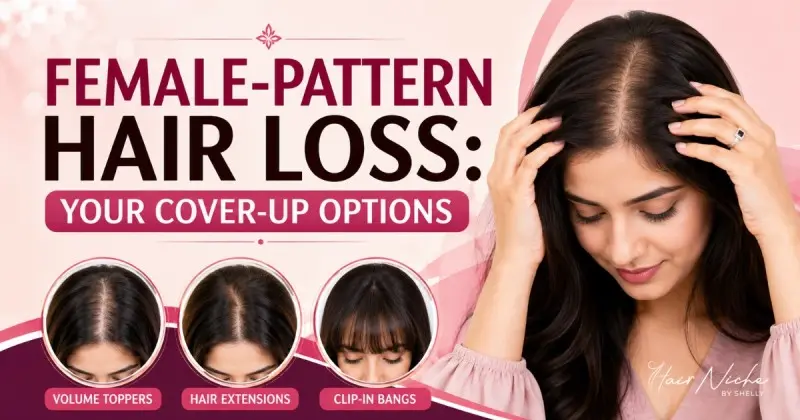
If your part is widening or your ponytail feels thinner, you may be seeing female-pattern hair loss — the most common cause of thinning in women. It's a gradual, diffuse loss over the top and crown, usually genetic or hormonal, and often more noticeable after menopause. A doctor can advise on treatment; meanwhile, a volumizer, topper or wig covers it beautifully.
That widening part is unsettling to watch, and the worry it brings is completely valid. This isn't medical advice, and it won't promise regrowth — but it will explain, calmly, what female pattern hair loss is and lay out the cover-up options that let you feel like yourself while you take the medical side into your own hands.
In this guide
- What it is
- The signs to look for
- Why it happens
- See a doctor — and why it helps
- Your cover-up options, by stage
- Gentle styling that helps
What female-pattern hair loss is
Female-pattern hair loss (also called androgenetic alopecia in women) is a gradual, diffuse thinning across the top and crown of the scalp. Unlike men, women rarely go fully bald; instead the hair becomes finer and less dense, and the parting gradually widens. It's the single most common cause of hair loss in women. For a reliable medical overview, DermNet's page on female pattern hair loss is a trustworthy reference.
The signs to look for
The tell-tale signs are quiet and gradual: a widening part, a thinner-feeling ponytail, more scalp showing at the crown under bright light, and hair that's lost its old fullness. The hairline usually stays intact — the thinning sits behind it, over the top of the head. If you're unsure whether what you're seeing is shedding or true thinning, our guide to hair fall vs thinning vs hair loss helps you tell them apart.
Why it happens
It's largely genetic and hormonal — a sensitivity of the hair follicles that causes them to gradually produce finer hair over time. It can begin at any age but often becomes more noticeable around and after menopause, when hormone levels shift. Because the cause is internal, styling can't reverse it — but it can be covered beautifully, and a doctor can discuss treatments that may slow it.
See a doctor — and why it helps
Because several conditions can look similar (and some, like thyroid issues or iron deficiency, are treatable), it's genuinely worth seeing a GP or dermatologist. They can confirm what's going on and discuss treatment options that may slow the thinning or help maintain what you have. Covering it and seeking treatment aren't either/or — they work best together, and feeling confident day to day makes the whole journey easier.
Your cover-up options, by stage
The right cover depends on how far the thinning has progressed.
- Early, diffuse thinning → a volumizer. While your scalp is still covered but your hair has lost fullness, a clip-in volumizer adds back body and density in minutes.
- Crown or top thinning → a topper. Once scalp starts to show at the part or crown, a topper covers the area with a natural part and blends into the hair around it.
- A widening part → a part or crown piece. A smaller topper or patch focuses coverage right where the part has widened.
- Extensive thinning → a wig. If the loss is widespread, a full-head wig gives complete, confident coverage.
Not sure which stage you're at? Our topper vs patch vs wig vs volumizer decision guide maps each option to the amount of loss.
Gentle styling that helps
- Add volume at the roots to lift hair away from the scalp, so less shows through.
- Shift your part occasionally — a slightly zig-zag or side part disguises a widening line.
- Keep length manageable — very long, fine hair can look sparser; a little added body helps.
- Be gentle — avoid harsh tension and heat on already-fine hair.
You have more options than that first worried glance suggests
Female-pattern hair loss is common, gradual, and — importantly — very coverable. A volumizer for early thinning, a topper for the crown, a wig for extensive loss: there's a natural, confidence-restoring option for every stage, and none of them rule out treatment.
Speak to a doctor about the medical side, and let us help with the rest — book a free video consultation for a calm, private conversation, or explore our thin-hair solutions. You didn't cause this, and you don't have to just live with how it makes you feel.
This article is general information and support, not medical advice. It doesn't diagnose or treat hair loss. Please see a doctor or dermatologist for diagnosis and treatment options.
FAQs
1. What is female-pattern hair loss?
It's a gradual, diffuse thinning across the top and crown of a woman's scalp, also called androgenetic alopecia. It's the most common cause of hair loss in women and usually shows as a widening part.
2. What are the first signs of female-pattern hair loss?
A widening part, a thinner-feeling ponytail, and more scalp showing at the crown under bright light. The hairline usually stays intact while the top thins.
3. What causes female-pattern hair loss?
It's largely genetic and hormonal — a follicle sensitivity that gradually produces finer hair. It can start at any age but is often more noticeable after menopause.
4. Can female-pattern hair loss be reversed?
Styling can't reverse it, but a doctor can discuss treatments that may slow it or help maintain your hair. Cover options restore fullness in the meantime.
5. What's the best cover-up for a widening part?
A part-focused topper or patch covers a widening part precisely. For overall thinning that still covers the scalp, a volumizer adds fullness.
6. Should I see a doctor about female-pattern hair loss?
Yes. A GP or dermatologist can confirm the cause, rule out treatable issues like thyroid or iron problems, and discuss treatment options.
7. Will a topper look natural on thinning hair?
Yes, when it's sized to your thinning area, has a natural part, and is colour-matched. It blends into the hair around the crown for an undetectable finish.
8. Is female-pattern hair loss the same as going bald?
No. Women with female-pattern hair loss rarely go fully bald; the hair becomes finer and the part widens, but density is usually retained at the sides and back.
9. Does menopause cause female-pattern hair loss?
Hormonal changes around menopause can make existing female-pattern hair loss more noticeable. It's a common time for women to first notice thinning.
10. Can I cover it without waiting for treatment?
Yes. A volumizer, topper or wig covers the thinning immediately, and works perfectly well alongside any treatment your doctor recommends.