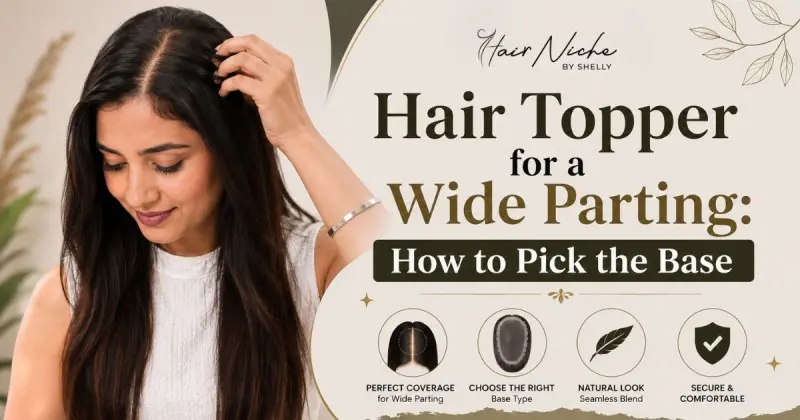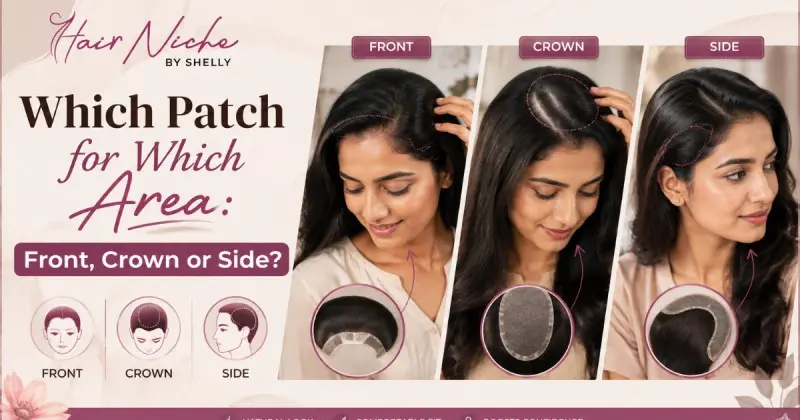
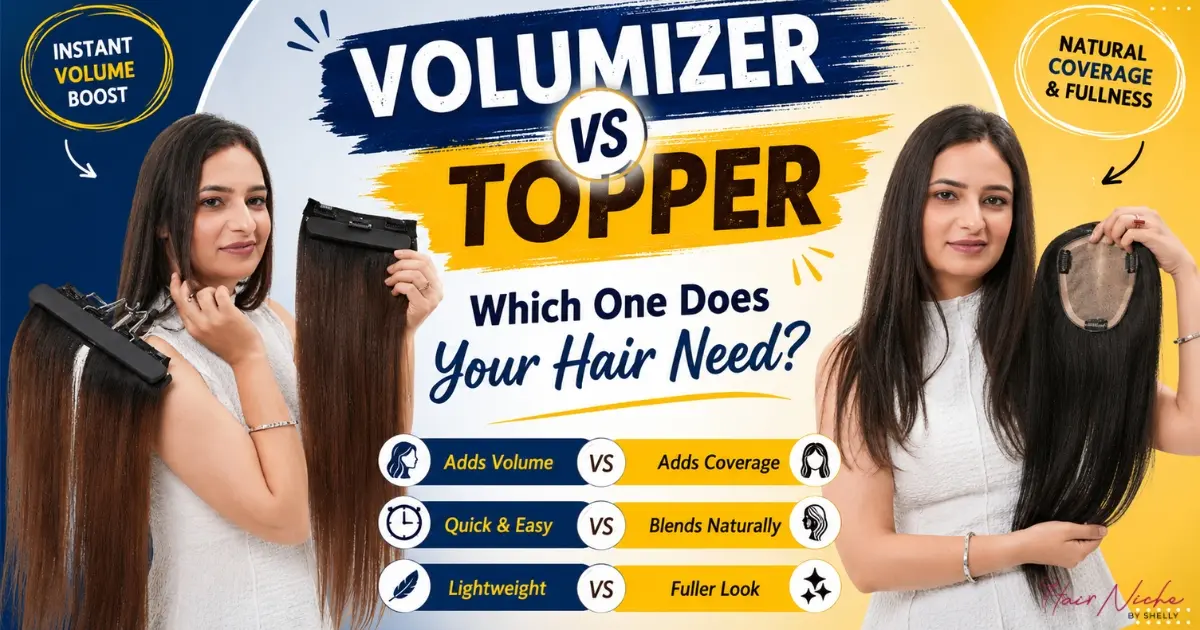
When your hair starts looking thinner, the internet throws two solutions at you — a volumizer and a topper — and rarely explains the difference. So you’re left worrying you’ll spend on the wrong one. It’s a fair fear, because they solve genuinely different problems. In the volumizer vs topper question, the short answer is this: a volumizer adds fullness where you still have hair, while a topper covers scalp where the hair has thinned away. Knowing which situation is yours is the whole decision.
This guide compares the two side by side — by what they cover, who they suit, and what they cost — so you buy the one your hair actually needs the first time.
What a volumizer does
A clip-in volumizer is a set of wefts you clip along the crown and mid-sections to add body, thickness and lift to the hair you already have. It doesn’t cover the scalp — it boosts the hair around it. Think of it as instant fullness for hair that’s gone fine, flat or limp, without any visible base or part.
It’s the answer when your hair still covers your scalp but has lost its density, bounce or that “just left the salon” body. Fine hair, hair thinned by age or hormones, and flat hair that won’t hold a style are all classic reasons women reach for a volumizer. Because the wefts sit under your own hair, nothing shows — you simply look like you have more hair than you did ten minutes ago.
What a topper does
A hair topper is a piece of hair tied into a base (mesh or silk) that clips over a specific area — usually the crown, top or part — to cover visible thinning. The base recreates a natural scalp and part, so where your own hair has become sparse enough to show scalp, the topper conceals it.
It’s the answer when you can see scalp through your hair at the crown or along the part, and volume alone won’t hide it. A well-matched topper doesn’t just add hair — it recreates a believable part and crown, which is why it conceals thinning that a volumizer would only pad around. The base sits close to your scalp and the clips anchor into the fuller hair surrounding the thin area.
Volumizer vs topper: side by side
When to choose a volumizer
Choose a volumizer if your hair is thinning diffusely but still covers your scalp — you want more body, a thicker ponytail, or fullness that’s drained away with age or heat styling. Our clip-in volumizers add that density in minutes without teasing or damage. If you’re unsure how many pieces you need, our 1 vs 2 vs 3-piece volumizer sets guide breaks it down.
When to choose a topper
Choose a topper if you can see scalp at the crown or part and want to conceal it, not just pad around it. A topper covers the area with a natural-looking base and part. Our hair topper size guide shows how to measure the area, and crown thinning vs full-top coverage helps you pick the right size.
The honest verdict
If the scalp shows, you need coverage — that’s a topper. If the hair’s just gone flat and fine, you need body — that’s a volumizer. Many women start with a volumizer for early, diffuse thinning and move to a topper if a specific area later needs concealing. There’s no wrong first step, only the one that matches what you see in the mirror today.
The most common mistake is buying a volumizer hoping it will hide a visible scalp — it won’t, because it has no base to cover the skin, and you’ll end up disappointed. The reverse mistake is buying a topper for hair that’s merely flat, then finding it’s more coverage than you needed. Match the tool to the problem and both work brilliantly.
If you’d like a second opinion, our stylists will look at your hair on a free video consultation and tell you which one fits — and colour-match you either way. Or, if you already know volume is your issue, browse the volumizers range and add fullness today. Still weighing up bigger coverage? Our full decision guide compares every option.
FAQs
1. What is the difference between a volumizer and a topper?
A volumizer adds fullness to the hair you already have and doesn’t cover the scalp. A topper has a base that covers a thinning area, concealing visible scalp at the crown or part.
2. Do I need a topper or a volumizer for thin hair?
If your scalp shows through, you need a topper for coverage. If your hair still covers your scalp but looks flat or fine, a volumizer for body is the right choice.
3. Can a volumizer cover a thinning crown?
Not really — a volumizer adds density around an area but doesn’t conceal visible scalp. For a crown where scalp shows, a topper is designed to cover it.
4. Which is more natural-looking?
Both look natural when colour-matched. A volumizer blends because it sits among your own hair; a topper looks natural when its base size and part match your thinning area.
5. Is a volumizer or topper better for fine hair overall?
For all-over fine hair with no visible scalp, a volumizer is usually best. A topper is better when the fineness has progressed to visible thinning in one area.
6. Can I use both a volumizer and a topper?
Yes. Some women use a topper to cover the crown and a volumizer through the lengths for overall body, especially for events or fuller styles.
7. Which lasts longer?
Both are durable when they’re real human hair and cared for properly. Lifespan depends on wear frequency and maintenance rather than the type.
8. Will either damage my own hair?
No. Both clip on gently and carry their own weight, so they don’t strain your natural hair when positioned and rotated sensibly.
9. Is a volumizer cheaper than a topper?
They overlap in price. Volumizer sets start around ₹9,500 and toppers from about ₹7,000, with larger, finer-base toppers costing more.
10. How do I decide without seeing them in person?
A free video consultation lets our stylists assess your thinning and recommend the right option and shade remotely, so you can order with confidence.
This is a guide to cosmetic volume and coverage options. If your thinning is sudden, patchy or worsening, it’s worth seeing a doctor or dermatologist as well, since some causes are treatable.