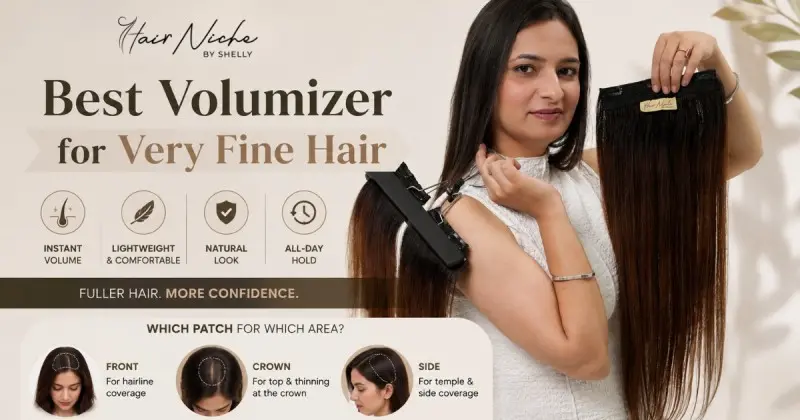
For very fine hair, the best volumizer is a lightweight clip-in with a small number of well-placed clips and density close to your own hair. Heavy multi-piece sets and wide wefts add volume but strain fine strands and risk showing through. Lighter and fewer beats bigger.
Fine hair has a particular problem with volumizers, and it isn't the volume. It's that everything shows. Clips that vanish in thick hair sit visibly in fine hair, and a weft that feels weightless to someone else can drag at your roots by lunchtime.
So the usual advice — buy the fullest set you can — is exactly wrong here.
What "very fine" actually changes
Fine hair describes the width of each strand, not how many you have. Fine strands are lighter and more flexible, which means two things for a volumizer: there's less hair to conceal a clip, and less tensile strength to carry weight.
That's why the piece that works isn't the biggest one. It's the one that adds visible body while staying light enough to sit unnoticed.
What to look for in a fine-hair volumizer
Light density. Density close to your own hair blends; density far above it creates an obvious step where the piece ends and your hair begins.
Fewer, well-placed clips. Every clip needs enough hair to grip and conceal it. On fine hair, a smaller number of clips placed where your hair is densest works better than many clips spread thin.
Real human hair. Fine hair is soft and matte, and synthetic fibre's shine sits against it obviously. Human hair also lets you heat-style the piece to match your own texture.
Weight you can carry all day. If it tugs after two hours, you won't wear it — which makes it the wrong piece regardless of how good it looks.
Where to start: a single, light set
For most women with very fine hair, one lightweight set is the right starting point rather than a multi-piece bundle. The One Set Volumizer (4 Clips) gives crown and mid-length body from a single piece, so there's only one attachment line to conceal.
If you want something even simpler for everyday wear, All Day Hair is designed as a light, quick option rather than a full event set.
Once you know a light set sits comfortably, you can size up. The One Set With Extra Density Volumizer adds more body while still being a single piece — useful if your hair is fine but you have plenty of it.
Placement matters more on fine hair
Even the right piece looks wrong in the wrong spot. Three rules:
- Clip into your densest hair, usually slightly back from the crown, not into the sparsest section.
- Leave enough hair above the clips to fall over and cover them — lift a wider top section than you think you need.
- Move the clips. Same spot every day on fine strands is how tension damage starts.
If your hair is fine and you can see scalp at the parting, a volumizer alone won't hide that. Volumizers add body around hair; they don't cover skin. In that case a topper is the better tool.
Making it last on fine hair
Fine hair is less forgiving of friction, and so is a light volumizer. A few habits keep both in good shape:
- Brush the piece before and after wearing with a loop or wide-tooth brush, working from the ends upward.
- Wash it far less than your own hair. It doesn't collect scalp oil, so washing only when it looks dull keeps the hair softer for longer.
- Store it flat or hanging, never crushed in a drawer, so the wefts keep their shape.
- Take it out at night. Sleeping in clips is the fastest route to tension damage on fine strands.
Don't over-buy on day one
The most common fine-hair mistake is starting with a large multi-piece set because it promises the most transformation. It's heavier, it's more clips to hide, and it's a bigger adjustment. One light set worn confidently beats a big set left in a drawer.
Lighter is what wins here
On very fine hair, the volumizer that works is the one you forget you're wearing — light density, few clips, real hair, placed where your own hair can cover it. Volume you can wear every day is worth more than volume you wear twice.
If you're unsure whether your hair can carry a set, or whether you need volume or coverage, book a free consultation and we'll look at your hair and shade-match you before you order.
FAQs
1. What is the best type of volumizer for very fine hair?
A lightweight single clip-in set with light density and a small number of clips. It adds body without the weight or visible attachment points that heavier multi-piece sets create on fine hair.
2. Will clip-in volumizers show through fine hair?
They can if the clips are placed in sparse sections or the top layer is too thin to cover them. Clipping into your densest hair and leaving a generous top section over the clips prevents it.
3. Do volumizers damage fine hair?
Not when worn sensibly. Choose a light piece, clip into stronger sections rather than fragile ones, vary the clip position, and remove it at night to avoid constant tension in one place.
4. How many clips should a fine-hair volumizer have?
Fewer is usually better. Each clip needs enough hair to grip and hide it, so a modest number placed well outperforms many clips spread across thin sections.
5. Can a volumizer cover a visible scalp or parting?
No. Volumizers add fullness around existing hair but don't cover skin. If your scalp shows at the parting, a topper is the right piece for that.
6. Should I buy a single set or a multi-piece set?
Start with a single light set. It's easier to conceal, more comfortable, and tells you what your hair can carry before you invest in more coverage.
7. Is human hair better than synthetic for fine hair?
Yes, generally. Fine hair has a soft, matte quality that synthetic shine contrasts with, and human hair can be heat-styled to match your own texture.
8. How do I stop a volumizer from slipping in fine, silky hair?
Clip into slightly textured, dry hair rather than freshly washed slippery hair, and secure into the densest section available. A little texturising product at the clip point helps grip.
9. Will a volumizer make fine hair look thicker or just longer?
That depends on placement. Clipped higher, it adds body and crown lift; clipped lower, it mainly adds length. For thickness, position it where you want the fullness to sit.
10. How do I know if I need a volumizer or a topper?
If your hair is fine but still covers your scalp, a volumizer adds the body you're missing. If scalp is visible at the crown or parting, you need the coverage a topper provides.