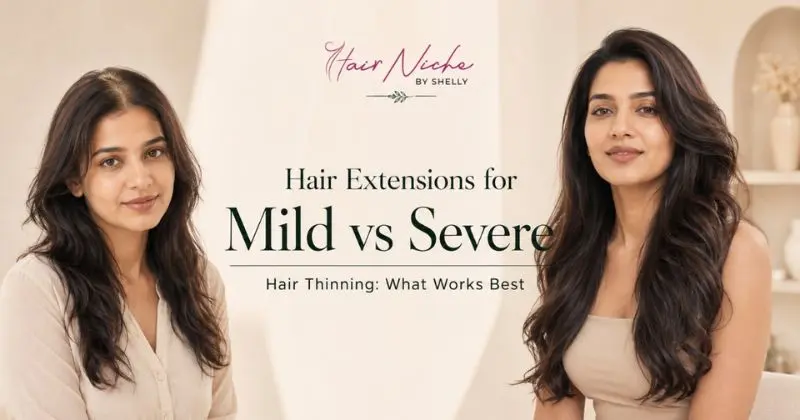
Hair thinning is not the same for everyone. Some people notice slightly less volume over time, while others experience visible scalp areas or significant shedding. Because of this, the best hair extensions depend heavily on whether thinning is mild or severe.
Choosing the wrong type can lead to discomfort, breakage, or an unnatural look. But choosing the right one can instantly restore confidence and create natural-looking fullness.
In this guide, we’ll break down hair extensions for mild vs severe hair thinning, what works best for each level, and what to avoid.
Understanding Mild vs Severe Hair Thinning
Before choosing extensions, you need to understand where you fall on the thinning scale.
Mild Hair Thinning:
- Slight reduction in volume
- Hair still covers scalp well
- Mostly noticeable in ponytails or parting
- Hair strands are still relatively strong
Severe Hair Thinning:
- Visible scalp in multiple areas
- Reduced density across the head
- Weak or fragile strands
- Hair may break easily or shed heavily
The difference matters because attachment weight and coverage needs are very different.
Why Extension Choice Changes With Thinning Level
Extensions work by adding hair weight and coverage but your natural hair must support them.
\text{Heavier extensions require stronger natural hair density to avoid traction and breakage}
If your hair is too weak for the extension type, it can lead to:
- Breakage
- Increased shedding
- Scalp tension
- Unnatural blending
That’s why the “one-size-fits-all” approach does not work.
BEST HAIR EXTENSIONS FOR MILD HAIR THINNING
If you have mild thinning, you still have flexibility. You can use a wider range of extensions safely as long as weight is controlled.
1. Clip-In Extensions (Best for Beginners)
Clip-ins are one of the most popular options for mild thinning because they are temporary and adjustable.
Why they work:
- No long-term commitment
- You control placement and volume
- Easy to remove daily
Best use case:
- Occasional styling
- Adding volume for events
- Quick transformation without damage
Important tip:
Use lightweight clip-ins and avoid stacking too many wefts in one area.
Insight: Stylists often recommend clip-ins for mild thinning because they allow full control over tension and placement.
2. Tape-In Extensions (Best Semi-Permanent Option)
Tape-ins are flat and lightweight, making them ideal for mild thinning.
Why they work:
- Distribute weight evenly
- Lie flat against the scalp
- Blend naturally with fine or medium hair
Best use case:
- Daily wear
- Natural-looking volume boost
- Long-term styling
Tape-ins are often recommended for fine or slightly thinning hair due to their lightweight structure and flat bonds.
3. Halo Extensions (Ultra-Gentle Option)
Halo extensions do not attach to the scalp at all.
Why they work:
- No clips or glue
- Zero scalp tension
- Easy to remove anytime
Best use case:
- Sensitive scalp
- Occasional volume boost
- Beginner-friendly styling
They are considered one of the safest and least damaging options for thinning hair.
Mild Thinning: What to Avoid
- Heavy sew-ins
- Thick micro-links
- Over-layered clip-ins
These can still strain your roots unnecessarily.
BEST HAIR EXTENSIONS FOR SEVERE HAIR THINNING
Severe thinning requires a completely different approach. The priority shifts from styling to protection and weight reduction.
1. Halo Extensions (Safest Overall Option)
For severe thinning, halo extensions are often the safest choice.
Why they work:
- No pressure on fragile roots
- No pulling or bonding
- Lightweight coverage only where needed
Best use case:
- Visible thinning at crown
- Fragile or shedding hair
- Temporary confidence boost
Because they avoid scalp contact, they eliminate tension-related damage risk.
2. Hair Toppers (Best Targeted Solution)
Hair toppers are designed specifically for thinning areas, especially the crown.
Why they work:
- Cover specific scalp zones
- Very lightweight bases
- Minimal attachment points
Best use case:
- Crown thinning
- Patchy density
- Medical or postpartum hair loss
They are one of the most effective solutions for visible thinning.
3. Lightweight Clip-Ins (Carefully Selected)
Clip-ins can still be used but only carefully.
Why they work:
- No long-term bonding
- Flexible placement
- Easy removal reduces stress
Rules for safety:
- Use very small wefts
- Avoid daily wear
- Never place near weak scalp areas
Note: Even clip-ins can create tension if worn too frequently or incorrectly on fine hair.
4. Tape-Ins (Only for Mild-to-Moderate Severe Cases)
Tape-ins can work for some severe thinning cases but only with caution.
Why they may work:
- Flat and lightweight bonds
- Even weight distribution
- Natural blending
Risks:
- Requires enough hair to support adhesive
- Needs professional installation
- Can slip if hair is too weak
Tape-ins are considered safe only when properly fitted and evenly distributed to avoid follicle stress.
Severe Thinning: What to Avoid Completely
Avoid these entirely if thinning is advanced:
- Sew-in extensions
- Heavy keratin bonds
- Large micro-link systems
These create tension that fragile hair cannot handle.
Experts warn that traction from heavy extensions can worsen thinning and lead to long-term hair loss.
Comparison: Mild vs Severe Thinning Solutions
How to Choose the Right Extensions Safely
Step 1: Assess scalp strength
If roots are weak → avoid all tension-based extensions.
Step 2: Decide your goal
- Volume boost → clip-ins or tape-ins
- Coverage → toppers or halo
- Full transformation → only if hair is strong enough
Step 3: Prioritize weight over length
Long extensions look great but heavy ones can worsen thinning.
Step 4: Choose human hair
High-quality human hair blends better and feels lighter on the scalp.
Brands like Hair Niche by Shelly focus on lightweight, natural human hair options designed to reduce strain and improve blending for different hair conditions.
Expert Tips for Thinning Hair Users
- Always start with the lightest option first
- Avoid daily tension styles
- Give your scalp rest days
- Use sulfate-free, gentle hair care products
- Brush carefully from ends upward
Final Thoughts
Choosing hair extensions for thinning hair is not about finding the most glamorous option and it’s about finding the safest and most suitable one for your hair condition.
- Mild thinning gives you flexibility with clip-ins and tape-ins
- Severe thinning requires gentle, non-invasive options like halos and toppers
The key is always the same: protect your natural hair first, enhance second.
With the right approach and high-quality, lightweight human hair options like those from Hair Niche by Shelly you can restore volume, confidence, and styling freedom without compromising hair health.
FAQs
Q1. Can I wear extensions if I have severe hair thinning?
Ans. Yes, but only lightweight, non-tension options like halos or toppers.
Q2. What is safest for mild thinning?
Ans. Clip-ins, tape-ins, and halo extensions.
Q3. Do extensions make thinning worse?
Ans. Only if they are too heavy or improperly installed.
Q4. Are tape-ins safe for thin hair?
Ans. Yes, for mild to moderate thinning when professionally applied.
Q5. What extensions should I avoid with severe thinning?
Ans. Sew-ins, keratin bonds, and heavy micro-links.
Q6. Can toppers help with bald spots?
Ans. Yes, they are designed for targeted coverage.
Q7. Are clip-ins safe for daily use?
Ans. No, they should be used occasionally for mild thinning.
Q8. Which extension feels most natural?
Ans. Lightweight human hair tape-ins and toppers.
Q9. Can extensions stop hair loss?
Ans. No, they only improve appearance—not treat hair loss.
Q10. What is the most comfortable extension overall?
Ans. Halo extensions are the most comfortable for all thinning levels.