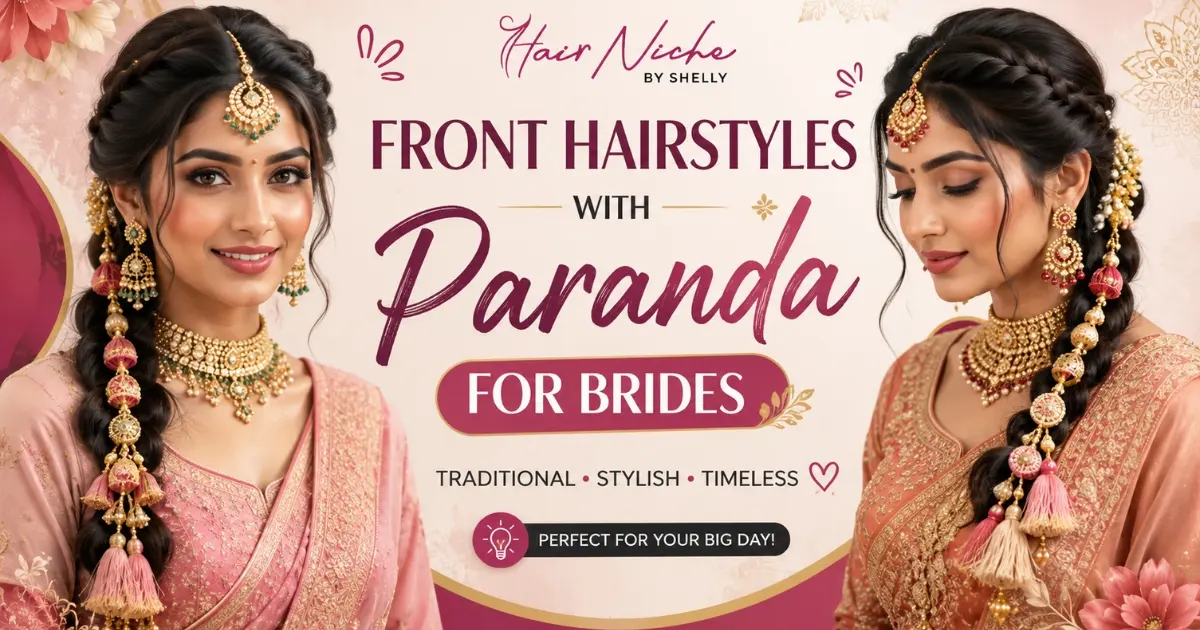
A paranda transforms the back of a bride's head into a work of art — but it's the front that frames her face in every phera, every doli moment, every close-up her family will keep forever. Most paranda advice stops at how to weave the braid and forgets the part that actually shows first. A beautiful front hairstyle with paranda is decided at the parting, the puff and the way the sides sweep back, long before the tassels swing.
Here are eight front looks to pair with a paranda, from a sleek centre part to a soft bridal puff, plus how to get the long, thick braid a paranda is meant to hang from — even if your own hair is fine or short.
How to choose your paranda front
Two things shape the decision: your face shape and the weight of your jewellery. A heavy maang tikka or matha patti needs a clean, structured front so nothing shifts under it. A softer floral bridal look suits a gentle puff and a looser braid.
And the honest bit most stylists skip: a paranda is built for a long, thick, single plait. If your hair is fine or shoulder-length, the braid ends up thin and the tassels do all the work. Adding real human-hair length is what lets the braid itself look as rich as the paranda tied into it — a full plait that swings with weight rather than a wispy one the paranda simply hides.
1. The sleek centre-parted front
The classic Punjabi bridal base. A clean centre part with smooth, flat sides is the perfect canvas for a maang tikka and lets the paranda braid down the back take centre stage. It suits nearly every face and photographs crisply.
2. The bridal front puff
A soft puff at the crown adds height and grace, flattering round faces and balancing tall jewellery. Fine hair can't hold a puff alone — a small clip-in volumizer gives smooth, lasting lift without teasing your hair to breaking point.
3. The rope-twisted front
Twist the front sections back from the face and pin them behind the crown for a secure, refined front that survives hours of ceremony and dancing. It keeps stray hair off the face and frames a centre tikka beautifully. The twist also adds a little height and texture at the crown, which flatters rounder faces and stops the front from looking flat under a heavy dupatta.
4. The side-swept front with a side paranda
Sweep the front to one side and carry the braid — and its paranda — over one shoulder. It's romantic and modern, lovely for a reception or a lighter function, and flattering if you want to soften a wider forehead.
5. The maang tikka front
Build the whole front around a statement tikka: centre part, sleek sides, and the paranda braid falling straight down the back for balance. The symmetry is timeless and deeply traditional.
6. The double-braid paranda
Two plaits, each finished with a paranda, framed by a neat centre-parted front — a folk-inspired, gidha-ready look that's full of movement. It needs length and density in both braids, which extensions make easy.
7. The bun-and-paranda fusion
A modern favourite: a decorated bun at the crown or nape with a paranda-finished braid trailing from it. For a full, firm bun base to anchor it, a clip-in piece from our buns and scrunchies range holds the weight and the tassels securely.
8. The soft half-up front
Crown pulled back for lift, length left flowing into a loose paranda braid — the relaxed, contemporary bridal front. It bridges tradition and trend and suits a lighter engagement or roka look.
Planning traditional South Indian elements too? Our south indian bridal front looks guide covers the jadai and kondai in detail.
If your hair won't carry a thick, long braid, a ready prandi/paranda ponytail piece gives you an instant full, long braid to tie your paranda into — no growing-out required. Not sure what your look needs? A free video consultation sorts it well before the wedding rush.
The braid deserves a front that frames the bride
Every stunning paranda look rests on two things: a front that frames the face and a braid full enough to carry the tassels. Real human-hair length and volume give a fine-haired bride both — a rich, thick plait and the fullness a puff or bun needs to sit right.
Match your look to your hair first: browse our paranda and ponytail pieces for an instant long braid, or take our 2-minute Hair Solution Quiz and we'll point you to what your chosen front needs. Styling younger family members for the wedding too? Our hairstyles for girls for wedding guide has short- and long-hair ideas.
FAQs
1. What front hairstyle suits a paranda best?
A sleek centre-parted front is the classic choice, as it frames a maang tikka and lets the paranda braid shine at the back. A soft front puff is the flattering alternative for round faces.
2. Can I wear a paranda if my hair is thin or short?
Yes. Clip-in extensions or a ready paranda ponytail piece give you the long, thick braid a paranda is designed for, so short or fine hair can still carry the look.
3. How do I get a thick, long braid for my paranda?
Add clip-in extensions before braiding, or use a paranda ponytail piece that already has the length and density built in.
4. What is a paranda exactly?
A paranda (or parandi) is a traditional Punjabi decorative tassel braided into the plait, adding length, colour and movement to a bridal braid.
5. Does a front puff suit every bride?
A puff is especially flattering on round faces and with tall jewellery, as it adds balancing height. Brides who prefer a sleeker look can skip it for a flat centre part.
6. Can I pair a paranda with a bun instead of a braid?
Yes. A bun-and-paranda fusion is a popular modern look, with the tasselled braid trailing from a decorated bun base for the best of both.
7. How do I keep my bridal front in place all day?
Use a structured base, plenty of U-pins, and firm clip-in pieces rather than loose padding. A trial before the wedding confirms it holds through the ceremony.
8. Will a heavy paranda pull on my own hair?
Not when the braid is built with a clip-in piece that carries its own weight. The extension holds the paranda, so there's no strain on your natural hair.
9. When should I do a paranda hairstyle trial?
Two to four weeks before the wedding, wearing any extensions or ponytail pieces you plan to use, so there are no surprises on the day.
10. Can I match a paranda ponytail to my own hair colour?
Yes. Real human-hair pieces come in natural black and brown shades and can be colour-matched to blend seamlessly with your own braid.