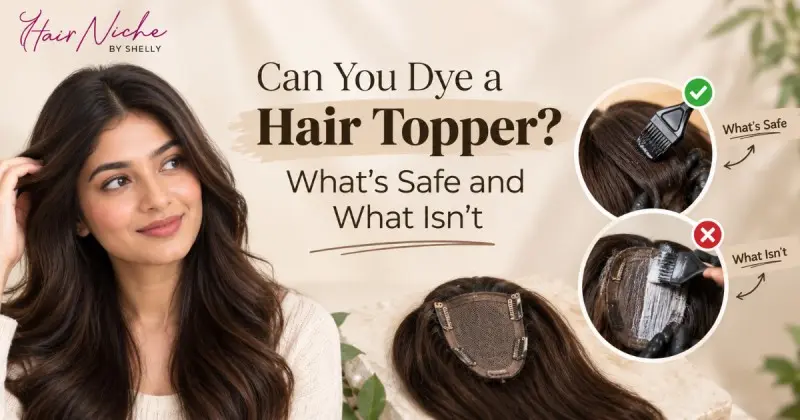
Yes — a human hair topper can be dyed, but only in one direction safely. Darkening and toning work well because they deposit colour. Lightening or bleaching is high risk, because processed hair has no living scalp to replenish it and can dry out or break. Darken, don't lift.
It's a fair question to ask before spending on a piece: if my own colour changes, or the shade isn't quite right out of the box, am I stuck with it?
The short answer is no, you're not stuck. The longer answer has one important asymmetry that most guides skip.
Why hair on a topper behaves differently
The hair on a topper is real human hair, so it takes colour the way your own hair does. What's missing is everything underneath it.
Your scalp produces oil that travels down each strand, and your hair grows, so damage eventually gets cut off. Neither happens on a topper. Any harshness you apply stays in that hair permanently, and the piece has no way to recover. That's the whole reason the rules are different.
It also explains why the hair on a topper needs conditioning more deliberately than your own — there's no natural oil reaching it.
Toning a topper: usually safe
Toning adjusts the tone without lifting the colour — knocking back brassiness, cooling a shade that's gone warm, or nudging a near-match into an exact one.
This is the lowest-risk colour change you can make, because it deposits rather than strips. It's also the change most people actually need, since a topper that's slightly off in tone is far more common than one that's wrong in depth.
Toning does fade with washing, so treat it as maintenance rather than a permanent change. Most pieces need it occasionally anyway: human hair without scalp oils tends to warm up slightly over months of washing and sun exposure, and a gentle tone brings it back to where it started.
Darkening a topper: generally fine
Going darker deposits pigment into the hair shaft. There's no lifting involved, so the structure isn't compromised, and results are usually predictable.
Two things to watch. First, human hair pieces often take colour faster than growing hair, so a full processing time can leave you darker than you intended — check early. Second, previously coloured hair can grab unevenly, so a strand test is genuinely worth the ten minutes.
Go gradually if you're unsure. Building depth over two gentle applications is recoverable; overshooting in one go means lifting the colour back out, which is the direction you're trying to avoid.
Lightening a topper: this is where they get ruined
Bleaching or lifting a topper is where most damaged pieces come from. Lightening works by opening the cuticle and stripping pigment out, which removes strength and moisture the hair cannot replace.
The result is often dryness, tangling and breakage that no conditioning treatment fully reverses — and by then you've damaged something you paid for rather than something that will grow back.
The practical rule: buy at or slightly lighter than your target shade. Darkening later is easy; lightening later is a gamble. If you want dimension, a piece made with lighter pieces already in it — like the Highlighted Hair Topper (Silk Base) — avoids the need to bleach anything.
A topper colour change, step by step
If you're going ahead with toning or darkening:
- Strand test first. Take hair from an underneath section, apply, and check timing and result before committing.
- Have it done professionally. Our own guidance on the hair toppers range is that colouring is best left to a professional, precisely because the piece can't recover from a mistake.
- Check early and often. Assume it will process faster than your own hair.
- Never colour the base. Keep product off the silk, lace or mono base — it can weaken and discolour it, and the base is the part that makes the topper look real.
- Deep condition afterwards. No scalp oils are reaching this hair, so replace the moisture yourself.
When it's better not to dye at all
If the shade is significantly wrong rather than slightly off, replacing beats rescuing. A big colour correction on a piece you can't repair is usually more expensive, in the end, than starting from the right shade — the Essential Hair Topper (Silk Base) and others come in a range of natural depths.
And if your own hair colour changes seasonally, matching a topper to your average shade rather than your current one saves repeated toning.
Deposit, don't lift
That's the rule worth remembering. Toning and darkening a human hair topper are perfectly workable, ideally with a professional and always after a strand test. Lightening is the one to avoid, because the hair has no way back.
Not sure whether your piece needs toning or a better-matched replacement? Book a free consultation and we'll look at the shade against your own hair before you put any colour near it.
FAQs
1. Can you dye a human hair topper?
Yes. Human hair toppers take colour like natural hair, but only darkening and toning are low-risk. Lightening or bleaching can permanently damage the hair, which can't repair itself.
2. Can you bleach or lighten a hair topper?
It's strongly discouraged. Lightening strips pigment and moisture from hair that has no scalp to replenish it, which commonly causes dryness, tangling and breakage.
3. Is toning a topper safe?
Toning is the safest colour change, because it deposits tone rather than stripping pigment. It's ideal for correcting brassiness or fine-tuning a near-match, and it fades gradually with washing.
4. Will a topper take colour faster than my own hair?
Often yes. Processed hair on a piece can absorb colour more quickly, so check the result early rather than leaving it for the full stated time.
5. Should I dye my topper myself or go to a salon?
Professionally is safer. A colourist can strand-test, control timing and keep product off the base — and unlike your own hair, a mistake here can't grow out.
6. Can I colour the topper's base as well?
No. Keep dye off the silk, lace or mono base. Colour can weaken and discolour it, and the base is what creates the natural-looking parting.
7. What happens if I dye a topper too dark?
Correcting overly dark colour means lifting it, which is the risky direction. That's why it's better to check early and build depth gradually than to over-process in one go.
8. How do I care for a topper after colouring it?
Deep condition it, because no scalp oils reach the hair. Use gentle sulfate-free products, wash less often than your own hair, and keep heat styling moderate.
9. Can I dye a topper to match my hair as it goes grey?
You can tone or darken it, but as grey spreads, a grey-blend piece usually matches better than repeatedly colouring a darker one.
10. Is it cheaper to dye a topper or buy the right shade?
For a small tonal adjustment, colouring is sensible. For a big shade change, buying the correct depth usually works out better than an expensive correction on a piece that can't recover.