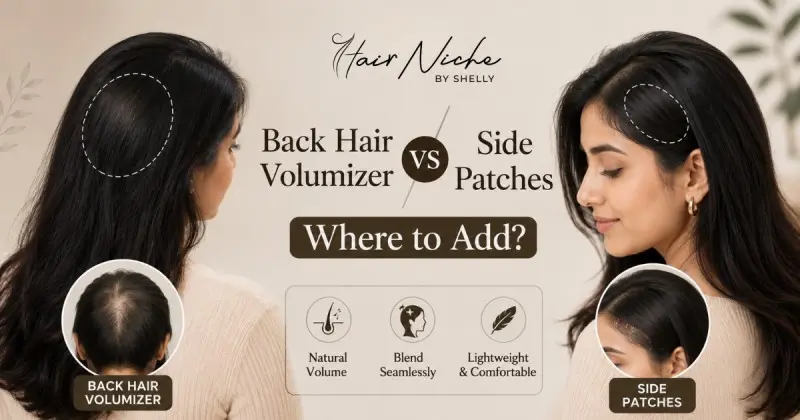
A back hair volumizer adds density behind the crown, where hair looks flat from the side and in photos taken from behind. Side patches fill gaps at the temples and above the ears, restoring width to the face frame. Choose by where the gap actually is.
Two women can both want "more volume" and need entirely different pieces. One has plenty of hair around her face but a flat, sparse back. The other has decent density behind and thin, receded temples that show every time she tucks her hair back.
Same complaint, opposite placement. Getting this wrong is the most common reason a volumizer disappoints.
Work out where the gap actually is
Two checks, in daylight:
For the back: take a photo of the back of your head, or use two mirrors. You're looking for flatness through the occipital area — the curve at the back of the skull — and whether the hair there looks noticeably thinner than the hair on top.
For the sides: tuck your hair behind your ears and look at your temples straight on. You're looking for recession at the corners of your hairline, gaps above the ears, or a face frame that has narrowed.
Whichever bothers you more when you look is where the volume belongs.
What a back hair volumizer does
A back hair volumizer sits behind the crown and fills out the back of the head. It's the piece for hair that reads flat in profile — the silhouette problem, where your hair looks fine from the front but collapses at the back.
Because it sits low and under your own hair, it's one of the easiest pieces to hide. The 2 Set Back Hair Volumizer is built for exactly that placement.
Choose it if photos from behind bother you, if your ponytail feels thin at the base, or if your hair loses shape by afternoon.
It also helps with a specific frustration: hair that looks fine when you leave the house and flat by evening. Adding structure at the back holds the shape for longer, because there's more hair supporting it.
What side patches do
Side patches clip along the sides to fill the temples and the area above the ears. They restore width where the hairline has receded at the corners, which is a common effect of years of tight ponytails and tension.
The Side Patches cover that zone. If you want length and body as well as gap coverage, Side Patches with Extra Volume add more.
Choose them if you avoid tucking your hair behind your ears, if updos expose thin temples, or if your face frame has narrowed.
They're also the piece most often bought too late. Temple recession creeps in slowly, and many women adapt their styling around it for years before realising there's something that simply fills it.
Volumizer placement, side by side
Volume at crown: neither of these
Worth being clear, because it's the most frequent mix-up. If the flatness is on top — at the crown or parting — neither of these is your piece. A crown volumizer or a topper covers that area.
Back pieces sit too low to lift the crown, and side patches sit too far out. Buying either for crown flatness is the classic wasted purchase. Our guide to hair volumizer clips covers the sets that span the crown, and the whole range is in hair volumizers.
Can you wear both?
Yes, and some women do — back pieces for shape, side patches for the face frame. Two cautions if you go that way.
First, add one at a time. Learn where each sits before layering. Second, watch total tension: more pieces means more clips, and if the temples are already receded from tight styles, adding permanent tension there defeats the purpose. Vary the positions and keep the hold gentle.
If the temple thinning is progressing rather than static, that's worth understanding before you cover it — thinning at the temples has causes worth checking with a doctor.
Place it where the gap is
Back for the profile, sides for the face frame, crown pieces for the top. It really is that simple once you've looked properly — and looking properly is the step most people skip.
Not sure what your photos are showing you? Book a free consultation and we'll look at the back and sides with you and recommend the placement.
FAQs
1. What is a back hair volumizer?
It's a clip-in piece that sits behind the crown to add density at the back of the head, filling out a flat profile and giving a fuller silhouette from the side and behind.
2. What are side patches used for?
Side patches fill gaps at the temples and above the ears. They restore width to the face frame where the hairline has receded, often from years of tight styles.
3. How do I know whether I need back or side volume?
Photograph the back of your head, then tuck your hair behind your ears and look at your temples. Whichever gap bothers you more in those two views is where the piece belongs.
4. Will a back volumizer add volume at my crown?
No. It sits too low to lift the crown. If the flatness is on top, you need a crown-spanning volumizer set or a topper instead.
5. Can I wear a back volumizer and side patches together?
Yes, though it's better to add one at a time. Watch the total number of clips, especially if your temples are already thin from tension.
6. Which is easier to hide?
A back volumizer, because it sits under your own hair with plenty of length falling over it. Side patches sit nearer the hairline, so they need more careful blending.
7. Do side patches help with a receding hairline at the temples?
They cover the gap and restore width, yes. They don't treat the cause, so if the recession is progressing it's worth getting it assessed.
8. Will clips at my temples make thinning worse?
They can if you attach in the same spot daily on already-fragile hair. Vary the position, keep the hold gentle, and remove the pieces at night.
9. Why does my hair look flat at the back but fine at the front?
Friction from pillows, chair backs and bag straps concentrates at the back, and you don't see that area daily, so it often thins or breaks before you notice.
10. Can I use side patches to make my hair look wider overall?
Yes. Adding width at the sides broadens the face frame, which is useful if your hair has narrowed and now sits close to your head.